General Electric (NYSE: GE) released earnings yesterday, and provided a detailed sector by sector view of how 2015 should develop around the globe. Confirming the outlook provided by other key global companies, they see strong growth in the US continuing through the next year. Reading through their transcript, the forecast for India and China appears to be a bit more subdued, and the major drags on the world economy will be Russia, Europe, and Japan.
The two major forces dragging on profits continue to be the strength of the US dollar and the extremely low price of oil. While the latter is helping a few sectors - primarily aviation and transportation - it is having a much more significant negative impact elsewhere. In fact, GE is already implementing job reductions, restructuring in certain areas, and the execution of simplification projects all in an attempt to reduce cost structures. The longer oil prices remain this low, the greater will be the impact.
The impact of oil prices can be felt in other areas as well. Subsea orders dropped 38%, and orders for drilling equipment dropped 72%. The decline makes sense, since oil is now trading below the break-even point for most types of extraction. Expect this area to continue to be depressed well into 2015, and expect to see regional economic pressures in areas dependent upon oil exploration and production.
The one energy area experiencing tremendous growth, however, is natural gas. Orders for turbo machinery related to natural gas were up 60%, primarily in North America, the Middle East, and Russia. That's not much of a surprise given the amount of natural gas produced in those three regions. It's a good indication that there are some plays out there in the exploration and production sector, since those companies were beaten to a pulp in the last quarter. Scouring that list for companies with a strong natural gas presence should provide an excellent entry opportunity.
As to the US dollar, there is no indication of weakening on the horizon. With the ECB's QE announcement on Thursday, in fact, there's further strength being forecast, coupled with a significant weakening of the Euro. This effect, however, is projected to be manageable. GE, for example, is forecasting only a $0.01 per share impact in 2015 based on currency exchange.
Aviation continues to be a major success story in the US and around the globe. Passenger Kilometers revenue was up 6.1% internationally and 5.3% in the US. If the price of fuel remains low, this revenue stream will continue to grow. Airlines should be a strong play at least through the first half of 2015. GE confirms what Alcoa told us a couple of weeks ago. Demand is extremely high, and GE experienced aviation orders up 15%. Equipment orders are up 8%, primarily from commercial engines. Again, that confirms what Alcoa was seeing for new aircraft orders, and it has me considering a play on B/E Aerospace before they report this week.
Healthcare is another growing segment in the US, up 9%. There is significant growth in diagnostic equipment orders for CT, Ultrasound, and MR. Globally, however, the sector is extremely depressed. There were sharp declines in Japan, Russia, and the Middle East. China is only expected to see modest growth in this sector for 2015. It looks like the healthcare plays for 2015 are primarily domestic.
Transportation experienced its strongest growth ever in 2014, driven primarily by a surge of locomotive orders in the US. That has to be great news for the freight industry, so we'll be taking a hard look at Union Pacific's forecast. (They released earnings on Thursday, so their transcript is available now.)
An interesting item that came out of their lighting department is the report of 72% growth in their LED business. LED comprised 27% of their revenues in that department, at a time when they saw a sharp decline in demand for traditional lighting products. This warrants a closer inspection since LEDs are now being used in a wide variety of consumer products. A surge in demand for LEDs implies very strong demand in consumer discretionaries as well as in technology, at least in the US.
Overall, the outlook from GE is similar to what we're hearing from other global companies. The US is strong, China moderate, but Europe, Russia, and Japan are economic millstones. Look to aviation, transportation, and healthcare for some strong growth. Consumer discretionary may also provide an opportunity based on hints from the lighting market, but that's going to require a closer inspection.
Saturday, January 24, 2015


Friday, January 23, 2015
IBM - a Once and Future Giant or Is It a Has Been?
For a company founded in 1911, you would think that 2015 would be a bit late for a mid-life crisis. That, however, is what appears to be happening with IBM (NYSE: IBM) since they no longer appear to know what they want to be when they grow up. That's assuming, of course, that IBM is able to recover from some extremely poor strategic decisions, coupled with an inability to deliver what the market truly requires.
Consider that, since the 1960s, IBM was the computer hardware company, driving the business technology world through the information revolution and into a world where computing technology is a given in our everyday lives. The phrase, "Nobody ever got fired for buying IBM" was inevitably heard in any management discussion regarding a decision on acquiring new technologies. Computer hardware and software was IBM's domain, and it was IBM's to lose. And lose it, they did.
After driving their competition out of business, IBM emerged as the sole provider of Mainframe hardware (including the current z/12 mainframe family and the just-announced z13 mainframe family.) They are also the sole provider of the mainframe operating systems as well as the only mainframe transaction processors (CICS, IMS, or Websphere for z/OS.) There's only one problem. IBM is not increasing their mainframe footprint, and existing mainframe customers are gradually migrating new applications into the non-mainframe space. The mainframe market is shrinking rapidly, and you can thank IBM's own internal marketing competition for that shrinkage.
IBM managed, though the early part of the 21st century, to undercut and cannibalize their own advantage. They introduced the P/Series hardware technology as a direct competitor, encouraging mainframe customers to migrate to the faster (at the time) mid-range technologies running their AIX operating system. The amount of Level 2 cache on the the P/Series boxes was a fraction of what was on the mainframe, though, so multi-tasking was not a forte in the mid-range space. Websphere Application Server (WAS) is the transaction processor of choice off the mainframe, however it's a major resource hog and can't compete with CICS when it comes to scalability, performance, or stability. (Ask any WAS specialist how often they hear "A JVM is looping." Stability and WAS are mutually exclusive.) Yet, the number of WAS licenses dwarfs the number of CICS licenses, thanks to IBM's efforts to increase P/Series and x86 based sales.
The industry trend now, is to migrate off the mid-range P/Series that IBM sold by the bushels a decade ago. AIX as an operating system was deemed too expensive and is rapidly losing to Linux as the Unix-based operating system of choice. Linux can run on all platforms - including the mainframe - and the application code running under Linux is highly portable. This is where scalability is factoring into the demise of IBM.
Unlike the monopoly IBM was able to develop in the mainframe space, the non-mainframe server space is highly competitive. HP is emerging as the market leader in that space. IBM was #2, but in a move that still mystifies me, IBM sold that advantage to Lenovo. The x86 server space is growing rapidly, and IBM gave it away. Dell is also in the top 3 in that space, giving customers plenty of options for the lower cost but highly scalable non-mainframe servers. When you look at the hardware filling all of those expanding data centers, you'll find endless racks of x86 based servers. Why would a major hardware company even think of abandoning that huge growth market?
In the database space, there are two main competitors and a bunch of also-rans. You're looking at either Oracle or DB2. On the mainframe, running under z/OS, DB2 is the only option (although there are still plenty of mainframe shops storing data primarily in VSAM, which comes with the operating system.) In the non-mainframe space, however, Oracle is a huge factor. In 2014, the two were neck-and-neck for market share with a very slight edge to IBM's DB2. Oracle, however, is gaining rapidly. With some of the acquisitions Oracle - the company, not the database - made over the past few years, they are now a force to be reckoned with in both the hardware and software spaces.
So what are IBM's plans for the future? Well, we know they've abandoned the chip market and they've abandoned the x86 market. They are hanging their hat on remaking themselves as a "Cloud Services" provider, a Software company, and, of course, they are touting the just-announced z13. It's not enough.
To be a viable cloud provider, they should never have abandoned their x86 business. The competition in that space is huge, and by selling the x86 to Lenovo, they have relinquished a huge cost advantage in that space. Let an HP or a Dell partner with either Oracle or EMC, and you'll have a stake driven through IBM's cloud-based heart. IBM's Global Services division - their technology outsourcing business - is hemorrhaging market share to the India based outsourcers. Let an Infosys, or a Wipro, or a TCS partner with one of those combinations I mention above and IBM's cloud dreams are down for the count.
On the z13 front, IBM mentioned all of the major buzz-words that make senior executives salivate. They mentioned "Cloud" and "Mobile" in the same breath, and that always makes the non-technical executives swoon. Under the covers, though, you merely have the next release in their standard mainframe offering with some improved performance, improved throughput in their FICON channels and their zIIP specialty engines. They've made some nice improvements in the zBX blade-bolt on to the mainframe. But, at the end of the day, it's still a mainframe, and you're not going to see anyone flock to the z13 to satisfy a cloud or mobile requirement. For existing mainframe customers, it may delay a migration to the distributed world, but it's not likely to attract new mainframe customers, and as companies world-wide continue to squeeze their expense budgets, new customers is precisely what IBM requires. They're not able to squeeze more revenue from their existing customer base.
The direction IBM is taking at the moment does not lead me to believe they are on the right course. Rather, I see them heading in the exact opposite direction from where they need to go. For now, the only thing IBM has going for it is its name. Of course, there was a time when one might have said the same for Sperry Rand.
Consider that, since the 1960s, IBM was the computer hardware company, driving the business technology world through the information revolution and into a world where computing technology is a given in our everyday lives. The phrase, "Nobody ever got fired for buying IBM" was inevitably heard in any management discussion regarding a decision on acquiring new technologies. Computer hardware and software was IBM's domain, and it was IBM's to lose. And lose it, they did.
After driving their competition out of business, IBM emerged as the sole provider of Mainframe hardware (including the current z/12 mainframe family and the just-announced z13 mainframe family.) They are also the sole provider of the mainframe operating systems as well as the only mainframe transaction processors (CICS, IMS, or Websphere for z/OS.) There's only one problem. IBM is not increasing their mainframe footprint, and existing mainframe customers are gradually migrating new applications into the non-mainframe space. The mainframe market is shrinking rapidly, and you can thank IBM's own internal marketing competition for that shrinkage.
IBM managed, though the early part of the 21st century, to undercut and cannibalize their own advantage. They introduced the P/Series hardware technology as a direct competitor, encouraging mainframe customers to migrate to the faster (at the time) mid-range technologies running their AIX operating system. The amount of Level 2 cache on the the P/Series boxes was a fraction of what was on the mainframe, though, so multi-tasking was not a forte in the mid-range space. Websphere Application Server (WAS) is the transaction processor of choice off the mainframe, however it's a major resource hog and can't compete with CICS when it comes to scalability, performance, or stability. (Ask any WAS specialist how often they hear "A JVM is looping." Stability and WAS are mutually exclusive.) Yet, the number of WAS licenses dwarfs the number of CICS licenses, thanks to IBM's efforts to increase P/Series and x86 based sales.
The industry trend now, is to migrate off the mid-range P/Series that IBM sold by the bushels a decade ago. AIX as an operating system was deemed too expensive and is rapidly losing to Linux as the Unix-based operating system of choice. Linux can run on all platforms - including the mainframe - and the application code running under Linux is highly portable. This is where scalability is factoring into the demise of IBM.
Unlike the monopoly IBM was able to develop in the mainframe space, the non-mainframe server space is highly competitive. HP is emerging as the market leader in that space. IBM was #2, but in a move that still mystifies me, IBM sold that advantage to Lenovo. The x86 server space is growing rapidly, and IBM gave it away. Dell is also in the top 3 in that space, giving customers plenty of options for the lower cost but highly scalable non-mainframe servers. When you look at the hardware filling all of those expanding data centers, you'll find endless racks of x86 based servers. Why would a major hardware company even think of abandoning that huge growth market?
In the database space, there are two main competitors and a bunch of also-rans. You're looking at either Oracle or DB2. On the mainframe, running under z/OS, DB2 is the only option (although there are still plenty of mainframe shops storing data primarily in VSAM, which comes with the operating system.) In the non-mainframe space, however, Oracle is a huge factor. In 2014, the two were neck-and-neck for market share with a very slight edge to IBM's DB2. Oracle, however, is gaining rapidly. With some of the acquisitions Oracle - the company, not the database - made over the past few years, they are now a force to be reckoned with in both the hardware and software spaces.
So what are IBM's plans for the future? Well, we know they've abandoned the chip market and they've abandoned the x86 market. They are hanging their hat on remaking themselves as a "Cloud Services" provider, a Software company, and, of course, they are touting the just-announced z13. It's not enough.
To be a viable cloud provider, they should never have abandoned their x86 business. The competition in that space is huge, and by selling the x86 to Lenovo, they have relinquished a huge cost advantage in that space. Let an HP or a Dell partner with either Oracle or EMC, and you'll have a stake driven through IBM's cloud-based heart. IBM's Global Services division - their technology outsourcing business - is hemorrhaging market share to the India based outsourcers. Let an Infosys, or a Wipro, or a TCS partner with one of those combinations I mention above and IBM's cloud dreams are down for the count.
On the z13 front, IBM mentioned all of the major buzz-words that make senior executives salivate. They mentioned "Cloud" and "Mobile" in the same breath, and that always makes the non-technical executives swoon. Under the covers, though, you merely have the next release in their standard mainframe offering with some improved performance, improved throughput in their FICON channels and their zIIP specialty engines. They've made some nice improvements in the zBX blade-bolt on to the mainframe. But, at the end of the day, it's still a mainframe, and you're not going to see anyone flock to the z13 to satisfy a cloud or mobile requirement. For existing mainframe customers, it may delay a migration to the distributed world, but it's not likely to attract new mainframe customers, and as companies world-wide continue to squeeze their expense budgets, new customers is precisely what IBM requires. They're not able to squeeze more revenue from their existing customer base.
The direction IBM is taking at the moment does not lead me to believe they are on the right course. Rather, I see them heading in the exact opposite direction from where they need to go. For now, the only thing IBM has going for it is its name. Of course, there was a time when one might have said the same for Sperry Rand.
Wednesday, January 21, 2015
Netflix Posts Strong Results, But For How Long?
Netflix (NASDAQ: NFLX) posted better than expected earnings, revenue, and subscription growth after the close yesterday, propelling the stock to a 17.3% gain today. Of note are their projections for a consistent year over year gain of 5 million subscribers, coupled with their entry into international markets. At first glance, it's no wonder that the stock soared today.
It's prudent to question, however, just what the long term prospects are for this style of low-cost subscription based streaming. Challenges in this space are not limited to Netflix, so there's no provider of this service available today with an edge, and when it comes to availability and content Netflix is the clear winner. Today. They are available on more devices - especially in the older Blu Ray player market - and they are the hands-down winner when it comes to the number of shows or movies available. Today.
The fundamental problem facing Netflix is that we live in an instant gratification society, but for streaming content, the wait may be well over a year before it becomes available. Before a streaming license is granted, all other revenue streams are exhausted. The extremely popular HBO series "Game of Thrones," for example, is still not available for streaming on Netflix even though the series enters its fifth season this April. They offer it in their DVD subscription, but not their streaming subscription.
Another challenge facing these providers is the ability to maintain the licensing for existing content. Recently, for example, Netflix announced that their license with the BBC expires at the end of the month, and - except for a handful of popular shows - it is not being renewed. It's not uncommon for a viewer to be midway through watching a series when the license is pulled and the remainder of the series becomes unavailable. (This happened to me with the Highlander series in which the license was pulled when I had only the last episode - the second half of a cliff-hanger - to watch in the entire series!)
While Netflix must deal with the frustrations of its current user base, the number of competitors in that space continue to grow stronger. Amazon Prime and HuluPlus are two with a similar model, and both are adding content at a very rapid pace. They are all competitively priced. While they, too, suffer from the same licensing issues, they are all competing for the same customer demographic.
In their Letter to Shareholders that accompanied the earnings announcement, Netflix admitted that they have serious competition from piracy, and a graphic they used to accompany the release showed BitTorrent styled client "Popcorn Time" surging into the Netflix market share space in September 2014, and keeping pace with Netflix ever since. There are plenty of other pirate streaming sites out there that are equally popular, and that popularity is growing. Piracy would be far less of an issue of Netflix were able to secure the licensing for current shows.
One pay-as-you-go site that is a real threat to Netflix is Vudu. This site allows you to buy or rent movies and TV shows almost immediately, and for a very competitive price. The most current episode of a TV show is available immediately, even before it appears in an On Demand menu at your cable provider. When it comes to legal - not pirated - instant gratification, this service fulfills every need.
Original content is the way subscription services are getting around the instant gratification issue, however the competition in that space is growing rapidly. Amazon Prime and Netflix are adding original content at a rapid pace, so there's really no edge to Netflix here.
For the moment, I understand Netflix' soaring stock price, and I understand the enthusiasm around the subscription rates. What I don't believe, however, is that it is sustainable. As other providers enter the game, as the popularity of current-show services (like Vudu) grows, and as major players like HBO begin to offer their own streaming for shows, I expect the decline in Netflix' subscriptions to be rapid. Time will tell, but I don't think time is on the side of Netflix.
It's prudent to question, however, just what the long term prospects are for this style of low-cost subscription based streaming. Challenges in this space are not limited to Netflix, so there's no provider of this service available today with an edge, and when it comes to availability and content Netflix is the clear winner. Today. They are available on more devices - especially in the older Blu Ray player market - and they are the hands-down winner when it comes to the number of shows or movies available. Today.
The fundamental problem facing Netflix is that we live in an instant gratification society, but for streaming content, the wait may be well over a year before it becomes available. Before a streaming license is granted, all other revenue streams are exhausted. The extremely popular HBO series "Game of Thrones," for example, is still not available for streaming on Netflix even though the series enters its fifth season this April. They offer it in their DVD subscription, but not their streaming subscription.
Another challenge facing these providers is the ability to maintain the licensing for existing content. Recently, for example, Netflix announced that their license with the BBC expires at the end of the month, and - except for a handful of popular shows - it is not being renewed. It's not uncommon for a viewer to be midway through watching a series when the license is pulled and the remainder of the series becomes unavailable. (This happened to me with the Highlander series in which the license was pulled when I had only the last episode - the second half of a cliff-hanger - to watch in the entire series!)
While Netflix must deal with the frustrations of its current user base, the number of competitors in that space continue to grow stronger. Amazon Prime and HuluPlus are two with a similar model, and both are adding content at a very rapid pace. They are all competitively priced. While they, too, suffer from the same licensing issues, they are all competing for the same customer demographic.
In their Letter to Shareholders that accompanied the earnings announcement, Netflix admitted that they have serious competition from piracy, and a graphic they used to accompany the release showed BitTorrent styled client "Popcorn Time" surging into the Netflix market share space in September 2014, and keeping pace with Netflix ever since. There are plenty of other pirate streaming sites out there that are equally popular, and that popularity is growing. Piracy would be far less of an issue of Netflix were able to secure the licensing for current shows.
One pay-as-you-go site that is a real threat to Netflix is Vudu. This site allows you to buy or rent movies and TV shows almost immediately, and for a very competitive price. The most current episode of a TV show is available immediately, even before it appears in an On Demand menu at your cable provider. When it comes to legal - not pirated - instant gratification, this service fulfills every need.
Original content is the way subscription services are getting around the instant gratification issue, however the competition in that space is growing rapidly. Amazon Prime and Netflix are adding original content at a rapid pace, so there's really no edge to Netflix here.
For the moment, I understand Netflix' soaring stock price, and I understand the enthusiasm around the subscription rates. What I don't believe, however, is that it is sustainable. As other providers enter the game, as the popularity of current-show services (like Vudu) grows, and as major players like HBO begin to offer their own streaming for shows, I expect the decline in Netflix' subscriptions to be rapid. Time will tell, but I don't think time is on the side of Netflix.
Tuesday, January 20, 2015
IMF Paints Dismal Picture for 2015
In what is sure to spook investors in companies with high global exposure, the International Monetary Fund (IMF) has lowered their global growth forecasts for 2015. The big hit was in their forecast for China, lowering their forecasts to a 6.8% growth rate. That's 0.8% lower than China experienced in 2014, and last year was already down from 2013.
That 6.8% growth rate is still almost double the anticipated growth rate world-wide, which the IMF is forecasting to decline to 3.5%. While Chief Economist Olivier Blanchard acknowledged that the declining price in oil was providing a bit of an economic boost, he does not believe that it will be enough to stem the amount of global economic weakness that is forecast.
Interestingly, the IMF only cut their forecast for the Eurozone to by 0.2% to 1.2%. From what we've seen to date, it's optimistic to assume that growth will be positive as Europe appears poised for recession. They also cut Japan drastically, and with a consumer confidence level under 40 and falling, that appears more than justified. In fact, the 0.6% growth level they are projecting may even be optimistic.
One major challenge related to validating the IMF's gloomy view of China is the lack of confidence in numbers produced by the Chinese government. Instead, we'll need to rely on forward guidance from some of the larger US corporations with high exposure in that region. Alcoa, for example, provided a stronger view of 2015 Chinese growth than is predicted by the IMF. Caterpillar reports next Tuesday (01/27) and it will be most beneficial to compare their forecasts with Alcoa's. Between CAT and AA, I trust their assessment of global economic conditions far more than I trust the judgement of either the Chinese government's reporting, or the somewhat pessimistic view of the IMF.
Despite my overall skepticism related to numbers coming out of China, there is one release this week that does warrant watch. The HSBC Manufacturing Purchasing Managers Index for China is released at 01:45 GMT on Friday (8:45 PM EST on Thursday.) The December number was 49.6, so there's a bit of interest in the direction it takes for January. A reading above 50 signals economic expansion, whereas a number below 50 signals contraction. It has been slowly - very slowly - trending down since 2009.
It's no exaggeration to say that China will make or break global economic health as we navigate a troubled period in Europe and Japan. A strong US dollar is not helping there since the Chinese Yuan is pegged to the dollar. The strong dollar is adding downward pressure on the health of their currency, which raises the prospect that they could decouple from the dollar for added relief. That may provide a needed boost by improving their export market.
There's a lot to consider related to China and it's interaction with other markets. For now, pay attention to the PMI number on Friday, but pay even closer attention to the guidance from companies with extreme exposure overseas. You can count on them being far more forthcoming than the numbers coming out of any government release.
That 6.8% growth rate is still almost double the anticipated growth rate world-wide, which the IMF is forecasting to decline to 3.5%. While Chief Economist Olivier Blanchard acknowledged that the declining price in oil was providing a bit of an economic boost, he does not believe that it will be enough to stem the amount of global economic weakness that is forecast.
Interestingly, the IMF only cut their forecast for the Eurozone to by 0.2% to 1.2%. From what we've seen to date, it's optimistic to assume that growth will be positive as Europe appears poised for recession. They also cut Japan drastically, and with a consumer confidence level under 40 and falling, that appears more than justified. In fact, the 0.6% growth level they are projecting may even be optimistic.
One major challenge related to validating the IMF's gloomy view of China is the lack of confidence in numbers produced by the Chinese government. Instead, we'll need to rely on forward guidance from some of the larger US corporations with high exposure in that region. Alcoa, for example, provided a stronger view of 2015 Chinese growth than is predicted by the IMF. Caterpillar reports next Tuesday (01/27) and it will be most beneficial to compare their forecasts with Alcoa's. Between CAT and AA, I trust their assessment of global economic conditions far more than I trust the judgement of either the Chinese government's reporting, or the somewhat pessimistic view of the IMF.
Despite my overall skepticism related to numbers coming out of China, there is one release this week that does warrant watch. The HSBC Manufacturing Purchasing Managers Index for China is released at 01:45 GMT on Friday (8:45 PM EST on Thursday.) The December number was 49.6, so there's a bit of interest in the direction it takes for January. A reading above 50 signals economic expansion, whereas a number below 50 signals contraction. It has been slowly - very slowly - trending down since 2009.
It's no exaggeration to say that China will make or break global economic health as we navigate a troubled period in Europe and Japan. A strong US dollar is not helping there since the Chinese Yuan is pegged to the dollar. The strong dollar is adding downward pressure on the health of their currency, which raises the prospect that they could decouple from the dollar for added relief. That may provide a needed boost by improving their export market.
There's a lot to consider related to China and it's interaction with other markets. For now, pay attention to the PMI number on Friday, but pay even closer attention to the guidance from companies with extreme exposure overseas. You can count on them being far more forthcoming than the numbers coming out of any government release.
Monday, January 19, 2015
France's Hollande Claims QE Announcement on Thursday
In a bit of political daring-do, French President François Hollande stated today that the European Central Bank (ECB) will announce a Quantitative Easing (QE) policy when it meets on Thursday. Given the ECB's strong resistance to political pressure, it's surprising to hear that Hollande is predicting the outcome of Thursday's meeting. Speaking to business leaders at the Élysée Palace, Hollande said, "On Thursday, the ECB will take the decision to buy sovereign debt, which
will provide significant liquidity to the European economy and create a
movement that is favorable to growth." The Stoxx Europe 600 soared to a 7-year high on the prospect.
This is a bit of a dangerous tightrope being walked by President Hollande, and given the number of false starts in the ECB QE saga, he is apparently doing it without a net. His comments came as a surprise to analysts despite widespread belief that the ECB will indeed take action this week. That action is already built into the bond market, in fact, which means a failure to act will result in some wild price action, especially now that Hollande has upped the ante by upstaging Draghi.
The question here, though, is what it means for the US markets. When Japan introduced their flavor of QE, that increased liquidity flowed right out of Japan and into the much stronger US and European markets. Similarly, when the US introduced QE, that money flowed out of the States and into emerging markets that were viewed as the stronger growth play at the time. It's reasonable, therefore, to assume that the US stocks and bonds markets will benefit from that increase in European liquidity.
There's no question that US bonds are a more attractive, more stable, and safer investment in the fixed-income space. The equity side, though, will benefit from the perceived strength of the US economy, rising in stark contrast to a European economy in a deflationary spiral on the brink of recession. The US Dollar will strengthen even further as a result of this move, however, and that will place added pressure on US equities that have significant exposure to Europe - meaning a large portion of the S&P 500. Short term, of course, there's likely to be excitement and buying pressure in US equities, even if that rise is short term over-exuberance.
At the very least, thanks to Hollande's comments, if Draghi's announcement on Thursday wasn't already the most anticipated economic release of the week, it has certainly vaulted onto that stage now. I suspect the news will at least take some of the downward pressure coming out of Europe off the table, at least through the early part of the week. Whether or not the "buy on rumor; sell on news" adage manifests, though, will be one to watch. After all the anticipation, it's possible that Draghi's press statements on Thursday will be anti-climatic. The market expects the QE package to include €500 billion to €600 billion of sovereign bonds, and another €400 billion in private assets. Failure to deliver on that expectation will almost certainly be punished in the US, UK, and European markets.
The ECB will announce their interest rates decision Thursday at 12:45 GMT (7:45 EST) and the much anticipated ECB Monetary Policy Statement and Press Conference follows at 13:30 GMT (8:30 EST). With the US markets opening an hour after that press conference starts, expect much of the morning's trading to be dominated by reaction to Draghi's comments.
This is a bit of a dangerous tightrope being walked by President Hollande, and given the number of false starts in the ECB QE saga, he is apparently doing it without a net. His comments came as a surprise to analysts despite widespread belief that the ECB will indeed take action this week. That action is already built into the bond market, in fact, which means a failure to act will result in some wild price action, especially now that Hollande has upped the ante by upstaging Draghi.
The question here, though, is what it means for the US markets. When Japan introduced their flavor of QE, that increased liquidity flowed right out of Japan and into the much stronger US and European markets. Similarly, when the US introduced QE, that money flowed out of the States and into emerging markets that were viewed as the stronger growth play at the time. It's reasonable, therefore, to assume that the US stocks and bonds markets will benefit from that increase in European liquidity.
There's no question that US bonds are a more attractive, more stable, and safer investment in the fixed-income space. The equity side, though, will benefit from the perceived strength of the US economy, rising in stark contrast to a European economy in a deflationary spiral on the brink of recession. The US Dollar will strengthen even further as a result of this move, however, and that will place added pressure on US equities that have significant exposure to Europe - meaning a large portion of the S&P 500. Short term, of course, there's likely to be excitement and buying pressure in US equities, even if that rise is short term over-exuberance.
At the very least, thanks to Hollande's comments, if Draghi's announcement on Thursday wasn't already the most anticipated economic release of the week, it has certainly vaulted onto that stage now. I suspect the news will at least take some of the downward pressure coming out of Europe off the table, at least through the early part of the week. Whether or not the "buy on rumor; sell on news" adage manifests, though, will be one to watch. After all the anticipation, it's possible that Draghi's press statements on Thursday will be anti-climatic. The market expects the QE package to include €500 billion to €600 billion of sovereign bonds, and another €400 billion in private assets. Failure to deliver on that expectation will almost certainly be punished in the US, UK, and European markets.
The ECB will announce their interest rates decision Thursday at 12:45 GMT (7:45 EST) and the much anticipated ECB Monetary Policy Statement and Press Conference follows at 13:30 GMT (8:30 EST). With the US markets opening an hour after that press conference starts, expect much of the morning's trading to be dominated by reaction to Draghi's comments.
Keeping an Eye on Southwest Airlines
Southwest Airlines (NYSE: LUV) reports earnings at 6:30 AM EST this Thursday. The conditions are ripe for this low-budget airline to continue to their steady upward climb. In their October announcement, they talked a bit about their entry into the international market, and with fuel costs driving downward and the strength of the US Dollar driving upward, there couldn't be a better time for them to branch out beyond our borders.
They plan to offer flights to Costa Rica starting in March, which is a perfect time weather-wise to vacation in that beautiful Central American tourist spot. It will be interesting to see if there's any mention of ticket sales to that destination in Thursday's conference call. International travel currently accounts for only 1% of Southwest's business, so the potential global upside is tremendous. They describe their international plans for 2015 as "modest" and that suits me just fine. Slow and steady, gaining reputation and market share, provides opportunity for long-term continuous growth.
Throughout the last quarter, Southwest continued to add destinations. They added seven new non-stop destinations in October, and eight more in November. As a reminder, they acquired a number of slots at Ronald Reagan National Airport (DCA) from American Airlines, and that has allowed them to add 44 new daily departures to seven new destinations.
International flights from Houston won't be coming online until later in 2015, so you won't see that reflected in Thursdays numbers, but it's something to consider as you look at LUV's growth potential in the out-years. The cities they are targeting, though, are impressive. They already fly to Cancun, Mexico City, and Los Cabos from other cities in the US. Add Puerto Vallarta and San Jose, Costa Rica and Belize City, Belize to the list for 2015, along with a major US tourist spot: Aruba.
Their expansion in Love Field, Dallas has been highly successful, where they added 16 new destinations. Load capacity as of October was topping 90%, and as tourist travel increases in the US, demand for seats will be highly competitive. What makes Southwest even more attractive in this regard is that, in addition to very competitive ticket prices, they still permit travelers to carry two bags free on international flights. That's a sure-fire market share winner on competitive routes, although it will be interesting to see where they pick up that revenue stream that other airlines are currently grabbing.
Thursday's earnings announcement will be interesting. I believe Southwest has excellent growth potential, especially with their low-cost international travel, but some strong numbers and strong forward guidance will be necessary this week for Southwest to overcome their currently high valuation compared to earnings. In the meantime, stay tuned to Delta Airlines' earnings announcement tomorrow for some clues as to where this industry is headed in 2015.
They plan to offer flights to Costa Rica starting in March, which is a perfect time weather-wise to vacation in that beautiful Central American tourist spot. It will be interesting to see if there's any mention of ticket sales to that destination in Thursday's conference call. International travel currently accounts for only 1% of Southwest's business, so the potential global upside is tremendous. They describe their international plans for 2015 as "modest" and that suits me just fine. Slow and steady, gaining reputation and market share, provides opportunity for long-term continuous growth.
Throughout the last quarter, Southwest continued to add destinations. They added seven new non-stop destinations in October, and eight more in November. As a reminder, they acquired a number of slots at Ronald Reagan National Airport (DCA) from American Airlines, and that has allowed them to add 44 new daily departures to seven new destinations.
International flights from Houston won't be coming online until later in 2015, so you won't see that reflected in Thursdays numbers, but it's something to consider as you look at LUV's growth potential in the out-years. The cities they are targeting, though, are impressive. They already fly to Cancun, Mexico City, and Los Cabos from other cities in the US. Add Puerto Vallarta and San Jose, Costa Rica and Belize City, Belize to the list for 2015, along with a major US tourist spot: Aruba.
Their expansion in Love Field, Dallas has been highly successful, where they added 16 new destinations. Load capacity as of October was topping 90%, and as tourist travel increases in the US, demand for seats will be highly competitive. What makes Southwest even more attractive in this regard is that, in addition to very competitive ticket prices, they still permit travelers to carry two bags free on international flights. That's a sure-fire market share winner on competitive routes, although it will be interesting to see where they pick up that revenue stream that other airlines are currently grabbing.
Thursday's earnings announcement will be interesting. I believe Southwest has excellent growth potential, especially with their low-cost international travel, but some strong numbers and strong forward guidance will be necessary this week for Southwest to overcome their currently high valuation compared to earnings. In the meantime, stay tuned to Delta Airlines' earnings announcement tomorrow for some clues as to where this industry is headed in 2015.
Sunday, January 18, 2015
The Significance of Copper's Current Price Moves
As if the plunging prices of oil weren't enough to worry about, pundits are now citing a "crash" in copper prices as further confirmation that the health of the global economy is deteriorating rapidly. I've heard some question whether copper is signalling a global recession, or if it's signalling significant weakness in the US and China at the very least. Well, before we start forecasting impending doom, let's take a step back and look at this "crash" from a broader perspective. Here's the weekly chart of copper prices from 1/3/2000 to the present.
As you can see from the chart, Copper has a tendency to follow global economic health. Whether or not we can call it a leading indicator is somewhat doubtful, though, and in my view it would be a stretch of the imagination. The two shaded green areas on that chart show the extreme market crashes that followed the September 11 attacks in 2001 and the financial crisis in 2008.
Nobody will argue that any market indicator could have foreseen the market crash following a major terrorist attack, so there were no leading indicators that would have foreshadowed the post 9/11 crash. Yet, as you can see from this chart, Copper started heading down following a peak over a year earlier. Conclusion: there was no correlation between the two.
Look at the 2008 scenerio. Again, Copper was trading in a very gradual incline until the financial crisis hit, and it then followed global markets down, just like every other commodity. The key is, it followed, but it didn't lead. Benefiting from a plunging dollar and a surge in economic growth in China, Copper surged from mid-2008 until the Commodity Bubble burst in 2011.
The 2011 burst of that bubble was inevitable, since it was not possible for China to continue the level of growth it had sustained for the prior three years. As China slowed, so did the demand for copper, and the prices gradually declined. You can see from the chart, in fact, that the price managed to find some support around the 61.8% Fibonacci Retracement line, until it finally penetrated that line for good in November, 2014.
In the past two months, we've seen a significant drop in price back to the 50% Fibonacci line, but before we panic, let's stop and thing about what drives the price of copper. There are three factors:
1. Demand, primarily in China. Well, that demand appears to be holding steady. It's not growing, but neither is it dropping at any significant rate. In fact, some of the early guidance we're hearing out of companies with exposure to China seem to indicate modest growth there for 2015, so I don't think weakening demand is driving the price down.
2. Supply. Well, it's definitely possible that there's an increase in supply. There was speculation last week coming out of Morgan Stanley's commodities analysts that a drop in oil prices would encourage mining companies to increase their production of commodities such as copper. It's possible, but I doubt that's what we're seeing in the current price drop.
3. Strength of the US Dollar. Here, folks, we have the winner. The price of commodities, including copper, carries an inverse relationship to the value of the dollar. As the dollar increases, commodities prices fall. What we've had in the last few months is a very sharp increase in the value of the US Dollar, culminating with Friday's 10-year high against the Euro. This factor alone fully accounts for the sharp drop in copper prices last week.
Is the global economy weakening? I'd certainly say Europe's is weakening, but China appears to be holding steady, as is the economy in the US. Growth is weaker than I'd like it to be, but there's nothing out there indicating an imminent recession. So when we look at the plunging prices of commodities in general and copper in particular, let's not forget that it's more than a supply and demand equation. Factor in the value of the dollar and we have a perfectly good explanation for the behavior without resorting to a doom and gloom economic forecast.
 |
| $COPPER EOD Price |
Nobody will argue that any market indicator could have foreseen the market crash following a major terrorist attack, so there were no leading indicators that would have foreshadowed the post 9/11 crash. Yet, as you can see from this chart, Copper started heading down following a peak over a year earlier. Conclusion: there was no correlation between the two.
Look at the 2008 scenerio. Again, Copper was trading in a very gradual incline until the financial crisis hit, and it then followed global markets down, just like every other commodity. The key is, it followed, but it didn't lead. Benefiting from a plunging dollar and a surge in economic growth in China, Copper surged from mid-2008 until the Commodity Bubble burst in 2011.
The 2011 burst of that bubble was inevitable, since it was not possible for China to continue the level of growth it had sustained for the prior three years. As China slowed, so did the demand for copper, and the prices gradually declined. You can see from the chart, in fact, that the price managed to find some support around the 61.8% Fibonacci Retracement line, until it finally penetrated that line for good in November, 2014.
In the past two months, we've seen a significant drop in price back to the 50% Fibonacci line, but before we panic, let's stop and thing about what drives the price of copper. There are three factors:
1. Demand, primarily in China. Well, that demand appears to be holding steady. It's not growing, but neither is it dropping at any significant rate. In fact, some of the early guidance we're hearing out of companies with exposure to China seem to indicate modest growth there for 2015, so I don't think weakening demand is driving the price down.
2. Supply. Well, it's definitely possible that there's an increase in supply. There was speculation last week coming out of Morgan Stanley's commodities analysts that a drop in oil prices would encourage mining companies to increase their production of commodities such as copper. It's possible, but I doubt that's what we're seeing in the current price drop.
3. Strength of the US Dollar. Here, folks, we have the winner. The price of commodities, including copper, carries an inverse relationship to the value of the dollar. As the dollar increases, commodities prices fall. What we've had in the last few months is a very sharp increase in the value of the US Dollar, culminating with Friday's 10-year high against the Euro. This factor alone fully accounts for the sharp drop in copper prices last week.
Is the global economy weakening? I'd certainly say Europe's is weakening, but China appears to be holding steady, as is the economy in the US. Growth is weaker than I'd like it to be, but there's nothing out there indicating an imminent recession. So when we look at the plunging prices of commodities in general and copper in particular, let's not forget that it's more than a supply and demand equation. Factor in the value of the dollar and we have a perfectly good explanation for the behavior without resorting to a doom and gloom economic forecast.
Saturday, January 17, 2015
Schlumberger Hints at Global Growth, Oil Pressures in 2015
Schlumberger Limited's (NYSE: SLB) earnings conference call yesterday provided some interesting insight into the global growth potential for 2015 as well as a detailed view of the changing dynamics we are witnessing within the oil industry. For those not familiar with this global company, Schlumberger provides technology, project management, and information solutions to global oil and gas exploration and production (E&P) corporations. Their clients operate in over 80 countries, giving them a unique view into the health of the economy both domestic and global.
Despite currency weakening both in Russia and Europe, Schlumberger foresees healthy growth in the global economy, surpassing the growth seen in 2014. They see demand for oil increasing by about one million barrels per day by 2016. This is matched by the one million barrels per day increase being supplied by the global oil market.
The dramatic drop in prices that we've seen is primarily being driven by a significant increase in supply coming out of North America and Saudi Arabia. Globally, Saudi Arabia has shifted their strategy from one in which they sought to protect the price of oil via a manipulation of the supply to one in which they seek to protect their market share via an increase in supply regardless of the impact on price. It's a fundamental shift in philosophy, and it's one to which the rest of the world has yet to fully react.
The impact of this strategy shift and resulting price drop is already being felt. Exploration and Production (E&P) are down significantly, and are projected to drop by 25% to 30% in the US next year, coupled with a 10% to 15% drop globally. Already, some 400 oil rigs have been taken offline, due to profitability issues relative to the new oil price point.
Hydraulic Fracturing technologies in the US and Canada have made a significant contribution to the oversupply of oil coming out of North America. In the realm of cost, however, this technology is one of the highest - much higher than the cost of traditional oil wells that have both a lower start-up cost and a longer life span per site. (Production from fraked sites declines 45% per year as compared to 5% per year from traditional wells.) The Arabian oil companies have the lowest production costs and can therefore ride out this wave of low prices to the detriment of all competitors. The break-even point on some Arabian wells is a mere $10 per barrel. Average break-even in the Gulf-States is $27 per barrel. US Shale, on the other hand, has a break-even point optimistically at $50 per barrel, and some of the newer sites are even in the $80 per barrel range. Clearly, the Saudis have the price advantage and can win the market share game simply by holding prices below $50 per barrel indefinitely.
The impact is being felt beyond North America. In the North Sea, both UK and Norwegian oil-rig counts are lower today and are projected to be even lower in 2015. Those wells are simply not profitable at the current price point. Not only are rigs being taken offline worldwide, but applications for new wells are down over 50%, and Cap-Ex spend projections for next year are being lowered tremendously. Financing for new exploration and drilling is expected to be difficult to obtain, again due to profitability. That will be exacerbated by rising interest rates should that happen.
What this means in the medium to long term is two-fold. At the moment, Saudi Arabia is antagonizing one of the largest industries in their largest global political ally. Expect the petroleum lobby to begin to apply political pressure in the White House and in Congress, if that hasn't already started. This will change the politics between US and Saudi relations, and anytime you have a changing political dynamic in the Middle East, events can become very volatile very fast.
The second outcome will be tightening of supply, which will result in a rise in oil prices. Nobody is willing to predict when that will occur, but it's definitely on the horizon for sometime in 2015. Even if it's not an overt action taken by the industry, it will be a de facto result as the more expensive drilling operations either go offline until prices rise, or they go bankrupt in the face of insurmountable losses. A look at the overall break-even points for the various producers will provide an excellent investment opportunity since they are the ones most able to survive this downturn in price, and they are the companies that will reap the harvest when prices inevitably resume their climb.
Despite currency weakening both in Russia and Europe, Schlumberger foresees healthy growth in the global economy, surpassing the growth seen in 2014. They see demand for oil increasing by about one million barrels per day by 2016. This is matched by the one million barrels per day increase being supplied by the global oil market.
The dramatic drop in prices that we've seen is primarily being driven by a significant increase in supply coming out of North America and Saudi Arabia. Globally, Saudi Arabia has shifted their strategy from one in which they sought to protect the price of oil via a manipulation of the supply to one in which they seek to protect their market share via an increase in supply regardless of the impact on price. It's a fundamental shift in philosophy, and it's one to which the rest of the world has yet to fully react.
The impact of this strategy shift and resulting price drop is already being felt. Exploration and Production (E&P) are down significantly, and are projected to drop by 25% to 30% in the US next year, coupled with a 10% to 15% drop globally. Already, some 400 oil rigs have been taken offline, due to profitability issues relative to the new oil price point.
Hydraulic Fracturing technologies in the US and Canada have made a significant contribution to the oversupply of oil coming out of North America. In the realm of cost, however, this technology is one of the highest - much higher than the cost of traditional oil wells that have both a lower start-up cost and a longer life span per site. (Production from fraked sites declines 45% per year as compared to 5% per year from traditional wells.) The Arabian oil companies have the lowest production costs and can therefore ride out this wave of low prices to the detriment of all competitors. The break-even point on some Arabian wells is a mere $10 per barrel. Average break-even in the Gulf-States is $27 per barrel. US Shale, on the other hand, has a break-even point optimistically at $50 per barrel, and some of the newer sites are even in the $80 per barrel range. Clearly, the Saudis have the price advantage and can win the market share game simply by holding prices below $50 per barrel indefinitely.
The impact is being felt beyond North America. In the North Sea, both UK and Norwegian oil-rig counts are lower today and are projected to be even lower in 2015. Those wells are simply not profitable at the current price point. Not only are rigs being taken offline worldwide, but applications for new wells are down over 50%, and Cap-Ex spend projections for next year are being lowered tremendously. Financing for new exploration and drilling is expected to be difficult to obtain, again due to profitability. That will be exacerbated by rising interest rates should that happen.
What this means in the medium to long term is two-fold. At the moment, Saudi Arabia is antagonizing one of the largest industries in their largest global political ally. Expect the petroleum lobby to begin to apply political pressure in the White House and in Congress, if that hasn't already started. This will change the politics between US and Saudi relations, and anytime you have a changing political dynamic in the Middle East, events can become very volatile very fast.
The second outcome will be tightening of supply, which will result in a rise in oil prices. Nobody is willing to predict when that will occur, but it's definitely on the horizon for sometime in 2015. Even if it's not an overt action taken by the industry, it will be a de facto result as the more expensive drilling operations either go offline until prices rise, or they go bankrupt in the face of insurmountable losses. A look at the overall break-even points for the various producers will provide an excellent investment opportunity since they are the ones most able to survive this downturn in price, and they are the companies that will reap the harvest when prices inevitably resume their climb.
Intel Beats Forecasts, But 2015 Poses Challenges
Intel (Nasdaq: INTC) announced earnings Thursday, beating guidance but offering an interesting, although somewhat neutral to bearish, view of 2015. This is a period of significant transition for chip makers in general, and CEO Brian Krzanich painted an excellent picture of what will drive that market for good or ill in the coming year.
Over the past couple of years, there have been three primary markets in that arena: PCs, Tablets, and Phones. To those broad categories, we can add Wearables, and a new term, "Phablets." What's a phablet? Think in terms of the Samsung Galaxy Note - a cross between a phone and a tablet. So here we have the submarkets in which Intel and other chip manufacturers will compete in 2015.
PC sales, at least according to Intel, are expected to be flat over the coming year. That's not really surprising, but I'll be watching the forward guidance from Dell and HP for some confirmation on that front. Certainly, the ultrabook and 2-in-1 laptop/tablet hybrid will push the PC market a bit, but the chip margins there are still somewhat prohibitive. Both are expected to exploit Intel's Core-M chip, based on the 14-nanometer spec, but Intel is still suffering from the anticipated high start-up costs associated with that new technology. The margins will improve through 2015, but you may not see that improvement until the second half of the year. Still, it's a leader in the market, and Intel stands to benefit from it if demand for the laptop or tablet improves.
A large area of growth worldwide is in the cell phone space. There is rapid product turnover, and the technology built into new phones is growing exponentially. Here is where I think Intel's SoFIA technology will shine. SoFIA takes a dual-core Atom Silvermont processor set into a 28nm system-on-chip (SoC) configuration, and integrates that with a 3G MODEM. Now, in most of the US, 3G is a bit long-in-the-tooth, and consumers typically want 4G LTE technology on their new phones. Intel is delivering that in the first half of 2015, and they already have a nice deal in hand with Samsung. As this price-point drops, Intel stands to benefit tremendously.
I have some reservations about the phablet concept, though. Bridging the gap between the footprint of a traditional smartphone and the footprint of a tablet, the phablet seeks to increase overall appeal to the consumer of both markets. I'm not convinced. Yes, I'm aware that Amazon stated last year that they see consumers asking for either a smaller tablet or a larger phone, but I struggle to see where something the size of a Samsung Galaxy Note can truly be practical in the phone space. I may be proven wrong, but when I shopped for a phone last year, I chose the Galaxy S3 over the Galaxy S5 simply because the S3 had a smaller footprint and fit better on my belt. I hear similar comments about phone footprint anytime a group of us tech-heads gather for lunch or dinner and compare our newest toys. The large phone footprint is a problem, and I don't think it's a long-term survivor. Whether it's short-term enough to drive Intel's profits in 2015 is outside of my comfort zone, so for me this one's a pass.
The wearable market is another area that leaves me a bit squeamish. Yes, they are popular, and sales of wearables like the Fitbit have soared. Unfortunately, the word "fad" keeps bouncing around in my head every time I see one. At the end of the day, it's going to come down to how useful the consumer finds the data being provided by the wearable and so far I'm not reading much that's positive on that front. Talk of the FDA regulating the apps that store and present that data also concerns me.
What it comes down to in 2015 was very nicely summarized by Krzanich: "We'll grow at the rate the market does." He's right. The question for us is whether or not Intel is a good fit for our portfolios today. It's currently trading just over 17 times earnings, and it's also only 4% off its 52-week high. Dividend yield is currently 2.5%, which isn't bad in today's low interest rate market, but once rates start to rise that yield is going to start to look very unattractive. As much as I like this stock, I'm just not sure it has much room to run in the first half of the year. I'll feel a bit more comfortable when I see its margins drop as they expect in 2Q15, and I'd really like to see what Samsung has to say about their vision for 2015 in the phone and tablet space. The same is true for my interest in Amazon's forward guidance since they're the other major player in non-Apple tablets.
Interestingly, a number of analysts raised their price targets for Intel following this earnings announcement, and that may give the stock a short term boost. For a portfolio addition as opposed to a short-term trade, however, I'd like to see either a pullback in price or some indication for the end-buyers of Intel chips that there will be sustained growth to warrant a higher stock price. I'll keep INTC on my short-term trading watch list, but for now, it's not a part of my longer term investment portfolio.
Over the past couple of years, there have been three primary markets in that arena: PCs, Tablets, and Phones. To those broad categories, we can add Wearables, and a new term, "Phablets." What's a phablet? Think in terms of the Samsung Galaxy Note - a cross between a phone and a tablet. So here we have the submarkets in which Intel and other chip manufacturers will compete in 2015.
PC sales, at least according to Intel, are expected to be flat over the coming year. That's not really surprising, but I'll be watching the forward guidance from Dell and HP for some confirmation on that front. Certainly, the ultrabook and 2-in-1 laptop/tablet hybrid will push the PC market a bit, but the chip margins there are still somewhat prohibitive. Both are expected to exploit Intel's Core-M chip, based on the 14-nanometer spec, but Intel is still suffering from the anticipated high start-up costs associated with that new technology. The margins will improve through 2015, but you may not see that improvement until the second half of the year. Still, it's a leader in the market, and Intel stands to benefit from it if demand for the laptop or tablet improves.
A large area of growth worldwide is in the cell phone space. There is rapid product turnover, and the technology built into new phones is growing exponentially. Here is where I think Intel's SoFIA technology will shine. SoFIA takes a dual-core Atom Silvermont processor set into a 28nm system-on-chip (SoC) configuration, and integrates that with a 3G MODEM. Now, in most of the US, 3G is a bit long-in-the-tooth, and consumers typically want 4G LTE technology on their new phones. Intel is delivering that in the first half of 2015, and they already have a nice deal in hand with Samsung. As this price-point drops, Intel stands to benefit tremendously.
I have some reservations about the phablet concept, though. Bridging the gap between the footprint of a traditional smartphone and the footprint of a tablet, the phablet seeks to increase overall appeal to the consumer of both markets. I'm not convinced. Yes, I'm aware that Amazon stated last year that they see consumers asking for either a smaller tablet or a larger phone, but I struggle to see where something the size of a Samsung Galaxy Note can truly be practical in the phone space. I may be proven wrong, but when I shopped for a phone last year, I chose the Galaxy S3 over the Galaxy S5 simply because the S3 had a smaller footprint and fit better on my belt. I hear similar comments about phone footprint anytime a group of us tech-heads gather for lunch or dinner and compare our newest toys. The large phone footprint is a problem, and I don't think it's a long-term survivor. Whether it's short-term enough to drive Intel's profits in 2015 is outside of my comfort zone, so for me this one's a pass.
The wearable market is another area that leaves me a bit squeamish. Yes, they are popular, and sales of wearables like the Fitbit have soared. Unfortunately, the word "fad" keeps bouncing around in my head every time I see one. At the end of the day, it's going to come down to how useful the consumer finds the data being provided by the wearable and so far I'm not reading much that's positive on that front. Talk of the FDA regulating the apps that store and present that data also concerns me.
What it comes down to in 2015 was very nicely summarized by Krzanich: "We'll grow at the rate the market does." He's right. The question for us is whether or not Intel is a good fit for our portfolios today. It's currently trading just over 17 times earnings, and it's also only 4% off its 52-week high. Dividend yield is currently 2.5%, which isn't bad in today's low interest rate market, but once rates start to rise that yield is going to start to look very unattractive. As much as I like this stock, I'm just not sure it has much room to run in the first half of the year. I'll feel a bit more comfortable when I see its margins drop as they expect in 2Q15, and I'd really like to see what Samsung has to say about their vision for 2015 in the phone and tablet space. The same is true for my interest in Amazon's forward guidance since they're the other major player in non-Apple tablets.
Interestingly, a number of analysts raised their price targets for Intel following this earnings announcement, and that may give the stock a short term boost. For a portfolio addition as opposed to a short-term trade, however, I'd like to see either a pullback in price or some indication for the end-buyers of Intel chips that there will be sustained growth to warrant a higher stock price. I'll keep INTC on my short-term trading watch list, but for now, it's not a part of my longer term investment portfolio.
Consumer Confidence Soars, But There is a "But".
The University of Michigan's Consumer Sentiment Index soared to an 11-year high on Friday, tipping the scales at a whopping 98.2%. (Bloomberg: Consumer Sentiment in US Surgest to 11-Year High.) The economists surveyed were expecting a value of 94.1%. That they were so far off the mark, coupled with statements cited in the article, demonstrates a bit of a disconnect between the economists and a variety of the numbers.
It is not surprising that consumer sentiment soared. When it comes to spending, what influences the perception of the consumer the most is what is staring them in the face at virtually every major intersection: the price of gas. Next to gas prices, consumers are highly attuned to what they spend in the super market. As we've seen, the price of gas is in free-fall, and prices in the stores are relatively flat. Thus, consumers are happy for now. They are, however, also very skeptical, but more on that in a moment.
The other aspect that impacts the consumer's economic viewpoint is job security. Here is where I don't believe the picture is as rosy as economists would have us believe. We're into January now, which means much of the cyclical job loss has peaked. Consumers, for the most part, are comfortable thinking that, if they made it through December with their job intact, then there's a good chance they'll continue to be employed at least to the summer.
The number that is always staring them in the face is the unemployment number, currently at 5.6% nationally. Of all of the meaningless statistics that the government releases, however, this has to rank near the top for "worst of breed." The true measure of the employment situation is the Participation Index, not Unemployment, and as of December - the January number isn't out, yet - that figure sat at an abysmal 62.7%. It's the lowest value since 1978 - a period of post-Watergate economic stagnation and the start of economic distress that would last another 5 years.
One major difference between now and 1978, however, is that the Participation Rate was improving steadily then. The slope of that graph was positive, whereas today it's negative. Today, the Participation Rate is growing steadily worse.
There is a bit of a stabilization towards the end of 2014, as you can see in the graph, but the job picture is not good at all. There are certain industries, in fact, where it's dismal. Ask yourself if it's possible for someone to do your job out of a remote location (i.e. India) and if the answer is "yes" then you are at an extreme risk of job loss. It's as simple as that.
Look at the extreme disconnect between this graph, and the statement made by senior US economist Brian Jones: “We continue to generate jobs at a fairly rapid clip, and what you’re also seeing is consumers’ response to what I call a tax cut from lower gasoline prices. That frees up a lot of spending and that means they can purchase other goods and services.”
One glance at the Participation Index will tell you that, if jobs are being created, they certainly aren't going to Americans in search of work. That number is in free-fall, and as long as we continue to outsource our jobs to the third world, and as long as we continue to import h1b workers from the third world, the job situation in the US will continue to worsen.
As to the lower price of gas freeing up a lot of spending on goods and services, well, where is it? The retail sales number for December was a disappointment. This leads to my comment earlier regarding the skepticism of the consumer. Yes, gas prices are down, and yes, consumers have noticed it. But here's the big "But." Consumers do not believe it's here to stay. Very few consumers understand what drives the price of oil, and fewer still understand how that - and other factors - impact the price of gas at the pump. Instead, conspiracy theories abound. Many believe it's manipulated by the government, many believe that it's set by "big oil", and most believe that the price will skyrocket back up to $4 per gallon almost overnight. What consumers are not doing is looking at the extra $10 or $20 in their pockets at the end of the month as a reason to go out and buy something else.
Richard Curtin, the Michigan Survey director, made an interesting statement which calls into question the validity of the survey itself: “Gains in employment and incomes as well as declines in gas prices were cited by record numbers of consumers. More consumers spontaneously cited increases in their household incomes in early January than any time in the past decade.”
That statement troubles me for two reasons. First, we've seen that employment in general is not increasing. We know that the number of people working part time, instead of full time, has increased, and we can see from the graph that the number of people that have a job (out of the pool of people that want a job) is at a 36-year low. Think about that! The employment conditions have not been worse in almost 4 decades, and they continue to decline!
Second, we know that income is not increasing. It's barely keeping pace with inflation. Hourly earnings only increased by 1.7%. Inflation is sitting today at 1.6%. Factor in the increased cost of benefits in 2015, and families are losing money, not gaining it. About the only way to increase your income today is to go out and get a second or third part-time job - certainly not something that any consumer would view as a positive.
So yes, the consumer confidence number did increase significantly. Don't read too much into it. That increase is temporary exuberance driven entirely by the temporary sharp decrease in gas prices. Until I see tangible proof that consumers are doing anything with that extra money beyond paying down credit card and loan debt, I'll continue to treat the index as an interesting but relatively insignificant portion of the global picture.
It is not surprising that consumer sentiment soared. When it comes to spending, what influences the perception of the consumer the most is what is staring them in the face at virtually every major intersection: the price of gas. Next to gas prices, consumers are highly attuned to what they spend in the super market. As we've seen, the price of gas is in free-fall, and prices in the stores are relatively flat. Thus, consumers are happy for now. They are, however, also very skeptical, but more on that in a moment.
The other aspect that impacts the consumer's economic viewpoint is job security. Here is where I don't believe the picture is as rosy as economists would have us believe. We're into January now, which means much of the cyclical job loss has peaked. Consumers, for the most part, are comfortable thinking that, if they made it through December with their job intact, then there's a good chance they'll continue to be employed at least to the summer.
The number that is always staring them in the face is the unemployment number, currently at 5.6% nationally. Of all of the meaningless statistics that the government releases, however, this has to rank near the top for "worst of breed." The true measure of the employment situation is the Participation Index, not Unemployment, and as of December - the January number isn't out, yet - that figure sat at an abysmal 62.7%. It's the lowest value since 1978 - a period of post-Watergate economic stagnation and the start of economic distress that would last another 5 years.
One major difference between now and 1978, however, is that the Participation Rate was improving steadily then. The slope of that graph was positive, whereas today it's negative. Today, the Participation Rate is growing steadily worse.
 | |||
| Participation Rate - 1970 to Present |
There is a bit of a stabilization towards the end of 2014, as you can see in the graph, but the job picture is not good at all. There are certain industries, in fact, where it's dismal. Ask yourself if it's possible for someone to do your job out of a remote location (i.e. India) and if the answer is "yes" then you are at an extreme risk of job loss. It's as simple as that.
Look at the extreme disconnect between this graph, and the statement made by senior US economist Brian Jones: “We continue to generate jobs at a fairly rapid clip, and what you’re also seeing is consumers’ response to what I call a tax cut from lower gasoline prices. That frees up a lot of spending and that means they can purchase other goods and services.”
One glance at the Participation Index will tell you that, if jobs are being created, they certainly aren't going to Americans in search of work. That number is in free-fall, and as long as we continue to outsource our jobs to the third world, and as long as we continue to import h1b workers from the third world, the job situation in the US will continue to worsen.
As to the lower price of gas freeing up a lot of spending on goods and services, well, where is it? The retail sales number for December was a disappointment. This leads to my comment earlier regarding the skepticism of the consumer. Yes, gas prices are down, and yes, consumers have noticed it. But here's the big "But." Consumers do not believe it's here to stay. Very few consumers understand what drives the price of oil, and fewer still understand how that - and other factors - impact the price of gas at the pump. Instead, conspiracy theories abound. Many believe it's manipulated by the government, many believe that it's set by "big oil", and most believe that the price will skyrocket back up to $4 per gallon almost overnight. What consumers are not doing is looking at the extra $10 or $20 in their pockets at the end of the month as a reason to go out and buy something else.
Richard Curtin, the Michigan Survey director, made an interesting statement which calls into question the validity of the survey itself: “Gains in employment and incomes as well as declines in gas prices were cited by record numbers of consumers. More consumers spontaneously cited increases in their household incomes in early January than any time in the past decade.”
That statement troubles me for two reasons. First, we've seen that employment in general is not increasing. We know that the number of people working part time, instead of full time, has increased, and we can see from the graph that the number of people that have a job (out of the pool of people that want a job) is at a 36-year low. Think about that! The employment conditions have not been worse in almost 4 decades, and they continue to decline!
Second, we know that income is not increasing. It's barely keeping pace with inflation. Hourly earnings only increased by 1.7%. Inflation is sitting today at 1.6%. Factor in the increased cost of benefits in 2015, and families are losing money, not gaining it. About the only way to increase your income today is to go out and get a second or third part-time job - certainly not something that any consumer would view as a positive.
So yes, the consumer confidence number did increase significantly. Don't read too much into it. That increase is temporary exuberance driven entirely by the temporary sharp decrease in gas prices. Until I see tangible proof that consumers are doing anything with that extra money beyond paying down credit card and loan debt, I'll continue to treat the index as an interesting but relatively insignificant portion of the global picture.
Friday, January 16, 2015
Does 2015 Present a Perfect Travel Opportunity?
The Euro versus the US Dollar plunged to a 10-year low today and all signs indicate it will continue lower if the ECB implements some form of easing as they are expected to do next week. We've seen multi-year support in the 1.20 range, however today it has recently driven through that support and today dove under the 1.15 mark with no signs of looking up. Given global weakness and the prospects for some form of QE coming out of the ECB, there's no end to this trend in sight.
The exchange rate on the Euro alone is enough to entice travelers to look at European vacations in 2015. This is the best exchange rate we've seen for the US consumer in well over a decade. Making it even more attractive now, though, is the decline in oil prices that are helping keep airline ticket prices in check. Some forecasts suggest an overall decline in ticket prices for 2015, at least according to Expedia.
This is great news for traders in several sectors, especially if overall prices in the US remain low, gas prices remain low, and consumer confidence increases. We've already discussed Alcoa's views regarding overall growth in the airline industry, and what we see in the exchange rate supports that view. The airlines themselves should benefit since demand from increased tourism will offset any downward pressure on price, thus increasing their margin when combined with falling fuel prices.
With increased tourism and demand for air travel come increased aircraft orders for the major carriers. There's also the potential for increased maintenance requirements on the aircraft, so the suppliers of parts will benefit. Those airlines that have yet to squeeze passengers into every available nook and cranny will be placing orders to providers like B/E Aerospace for more seats, thinner bulkheads, etc.
Looking a bit further into the future, we see potential with Cuba as well. It was announced today that some of the travel restrictions there were lifted, making it easier to travel to Cuba without State Department approval provided the reason fits into twelve relatively broad categories. Unfortunately, tourism isn't one of them, but the writing is on the wall, there. I will be surprised if tourism isn't added to the list during the current presidential term. Cuba as a tourist resort provides a host of trading opportunities, so we'll be keeping a very close eye on political developments on that front.
For now, I'm watching the forward guidance provided by key players in the Materials, and Industrials. Consumer Discretionary will also provide a clue as to where the potential traveler is spending their money and where we think that is heading. The bottom line is that, even those of us that don't play FOREX, we have some excellent equity trading opportunities coming out of the falling Euro. Keep an eye on forward guidance in these sectors and trade accordingly.
 | ||||
| USD to EUR 10-Year Chart |
The exchange rate on the Euro alone is enough to entice travelers to look at European vacations in 2015. This is the best exchange rate we've seen for the US consumer in well over a decade. Making it even more attractive now, though, is the decline in oil prices that are helping keep airline ticket prices in check. Some forecasts suggest an overall decline in ticket prices for 2015, at least according to Expedia.
This is great news for traders in several sectors, especially if overall prices in the US remain low, gas prices remain low, and consumer confidence increases. We've already discussed Alcoa's views regarding overall growth in the airline industry, and what we see in the exchange rate supports that view. The airlines themselves should benefit since demand from increased tourism will offset any downward pressure on price, thus increasing their margin when combined with falling fuel prices.
With increased tourism and demand for air travel come increased aircraft orders for the major carriers. There's also the potential for increased maintenance requirements on the aircraft, so the suppliers of parts will benefit. Those airlines that have yet to squeeze passengers into every available nook and cranny will be placing orders to providers like B/E Aerospace for more seats, thinner bulkheads, etc.
Looking a bit further into the future, we see potential with Cuba as well. It was announced today that some of the travel restrictions there were lifted, making it easier to travel to Cuba without State Department approval provided the reason fits into twelve relatively broad categories. Unfortunately, tourism isn't one of them, but the writing is on the wall, there. I will be surprised if tourism isn't added to the list during the current presidential term. Cuba as a tourist resort provides a host of trading opportunities, so we'll be keeping a very close eye on political developments on that front.
For now, I'm watching the forward guidance provided by key players in the Materials, and Industrials. Consumer Discretionary will also provide a clue as to where the potential traveler is spending their money and where we think that is heading. The bottom line is that, even those of us that don't play FOREX, we have some excellent equity trading opportunities coming out of the falling Euro. Keep an eye on forward guidance in these sectors and trade accordingly.
Inflation, Industrial Production Show Slight Declines
The Consumer Price Index (CPI) for December came in at -0.4%, the greatest decline since 2008. The Core CPI - which excludes the cost of food and energy - came in flat at 0.0%. The rapid decline in the cost of oil and gas has clearly had a dramatic impact on prices. What the Core CPI is telling us, though, is that inflation - now only 1.6% - is showing no signs of approaching the 2% level that the Fed is reportedly using as their bellwether. The weakness in prices is not unexpected - the numbers were in-line with market surveys - but they are now fueling a very active debate around the timing of interest rate increases.
General consensus points towards a late 2nd quarter increase in interest rates. The weak economic numbers throughout the first half of January, however, are increasing speculation that the interest rate hikes may be delayed well into the 3rd quarter, and even as late as a mid-4th quarter increase. Nothing that I've seen thus far would lead me to believe that rate increases will come in the first half of the year. FOMC has a two-day meeting the last week of January, and the weak data to date should have even the hawks on the committee taking a wait-and-see position.
On the production side, the numbers released this morning were somewhat mixed. Industrial Production decreased 0.1% in December. That decrease follows a dramatic 1.3% increase in November. The bulk of the decline was in the Utilities sector, though, where heating demand dropped significantly. When you take utilities out of the equation, industrial production experienced a 0.7% increase. That's still a significant decline from the November numbers.
One encouraging note was a 1.4% rise in construction supplies. This will warrant a closer look, since we may have a trading opportunity in that sector. Defense and Space equipment rose 0.4% as did the production of materials with gains being seen in all major sectors.
The slope of Industrial Production over time is encouraging. It's showing healthy year-over-year growth with no signs of the flat and downward slope that serves as a harbinger of a recession. (Look at the months preceding recessions in the charts below.) This adds fuel to the argument that current weakness in the overall economy is short-term and a reflection of the global picture, not the domestic picture. What does concern me, however, is the strength of the US dollar. While our production is strong, our ability to export is going to weaken unless we can tame the growth of the dollar. That's another reason I don't believe a rate increase is imminent. With the current strength of the dollar, a rate increase will add further pressure on our exports. I just don't see the Fed ready to impose that pressure, and I don't see the key numbers - PPI, CPI, Retail Sales, and Consumer Confidence - moving in the direction the Fed needs before an increase is possible.
General consensus points towards a late 2nd quarter increase in interest rates. The weak economic numbers throughout the first half of January, however, are increasing speculation that the interest rate hikes may be delayed well into the 3rd quarter, and even as late as a mid-4th quarter increase. Nothing that I've seen thus far would lead me to believe that rate increases will come in the first half of the year. FOMC has a two-day meeting the last week of January, and the weak data to date should have even the hawks on the committee taking a wait-and-see position.
On the production side, the numbers released this morning were somewhat mixed. Industrial Production decreased 0.1% in December. That decrease follows a dramatic 1.3% increase in November. The bulk of the decline was in the Utilities sector, though, where heating demand dropped significantly. When you take utilities out of the equation, industrial production experienced a 0.7% increase. That's still a significant decline from the November numbers.
One encouraging note was a 1.4% rise in construction supplies. This will warrant a closer look, since we may have a trading opportunity in that sector. Defense and Space equipment rose 0.4% as did the production of materials with gains being seen in all major sectors.
The slope of Industrial Production over time is encouraging. It's showing healthy year-over-year growth with no signs of the flat and downward slope that serves as a harbinger of a recession. (Look at the months preceding recessions in the charts below.) This adds fuel to the argument that current weakness in the overall economy is short-term and a reflection of the global picture, not the domestic picture. What does concern me, however, is the strength of the US dollar. While our production is strong, our ability to export is going to weaken unless we can tame the growth of the dollar. That's another reason I don't believe a rate increase is imminent. With the current strength of the dollar, a rate increase will add further pressure on our exports. I just don't see the Fed ready to impose that pressure, and I don't see the key numbers - PPI, CPI, Retail Sales, and Consumer Confidence - moving in the direction the Fed needs before an increase is possible.
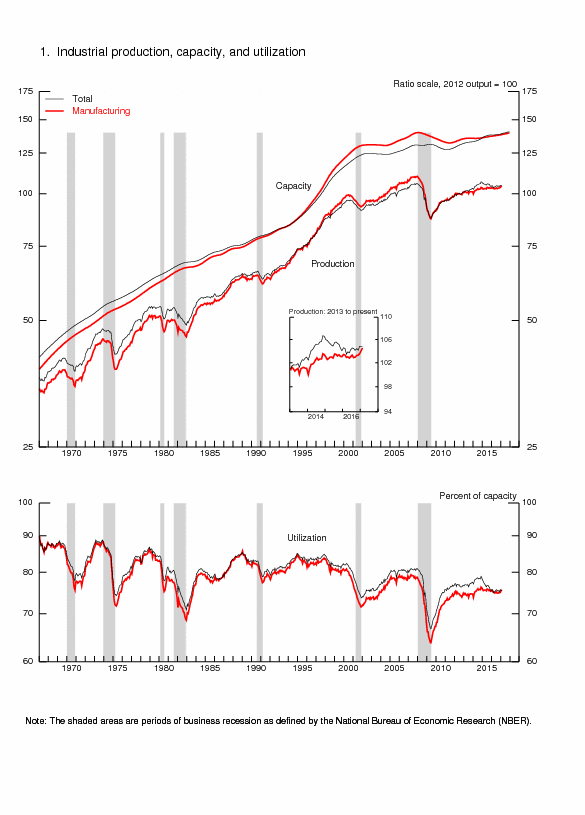 |
| Industrial Capacity and Production |
Thursday, January 15, 2015
Weak Retail Sales, PPI May Delay Fed Move
It's only January, and one month's data does not a trend make. Still, yesterday's dismal Retail Sales report for December, coupled with today's weak Producer Price Index (PPI) report will certainly give the Fed pause as it considers when and how much to raise interest rates.
Yesterday morning's Retail Sales report for December showed a dramatic decline of 0.9%, the weakest number since January 2013. While that sharp a decline may be an aberration, it's difficult to dismiss amidst all the other foreboding signs that the economy may not be as robust as first thought. Coming at a time when gas prices have been falling dramatically, though, it is certainly cause for concern, especially if we don't see a decent rebound next month.
The Producer Price Index (PPI) reported today, showed similar weakness, declining another 0.3%. This index has now fallen for four consecutive months, with December's decline being the steepest since 2011. While the price decline would signal good news for consumers, it will also signal to the Fed that inflation is not threatening to rise anytime soon. With these two numbers - Retail Sales and PPI - in hand, tomorrow's Consumer Price Index (CPI) should prove very interesting.
The US dollar continues to run very strong, and that strength is not going to help US exports. This is yet another reason I believe the Fed will further delay any interest rate increases. With inflation not showing any signs of challenging the 2% mark, and with a strengthening dollar adding further pressure overseas, I just can't see the Fed changing their posture in the first half of 2015.
What all this means for the broader economy is hotly debated. There's a widespread belief that consumers are spending the money saved from the plummeting cost of a tank of gas, however I'm frankly not seeing any evidence of that. I've discussed that with people I encounter in various settings, and have yet to hear actual consumers confirm that they see this as a windfall available to spend at will. What I do hear is that people are using it to pay down bills, and occasionally I hear that they're saving it, but that's about it. They're not spending it to the point where it is noticeable in the numbers.
This makes sense when you stop to think about it. The dropping price of gas is most beneficial to folks that are living close to paycheck-to-paycheck. It makes sense that they are most likely to have credit card or loan debt that needs to be paid down, and they're taking advantage of that little extra to do just that. They're not going out and buying something extra. Folks with little-to-no debt don't really notice the difference other than to mention by the water cooler that they just spent less to fill up their tank. This group was already spending what and when they wanted, so the extra few bucks isn't making a difference in their habits.
What is definitely making a difference is the lack of compensation in the form of merit increases on the job, and the erosion of corporate benefits. The price of health care increased dramatically for the average worker again this year, and - based on current surveys - merit increases are barely keeping pace with inflation. The drop in the price of gas is merely keeping the average worker's overall income on par with last year's, given increased benefits costs.
With each passing week, I'm increasingly bearish on the prospects for 2015. There's now bipartisan talk in Congress about a federal gas tax increase to replace lost revenue from the declining price of gas. Unfortunately, that will only exacerbate the impact when oil and gas prices inevitably resume their normal upward trend. Europe's continued weakness, coupled with a lackluster growth forecast (compared to prior years) for China and India have me concerned about global drag on the US economy. Draghi's inability to send clear and consistent signals about the ECB's plans aren't helping.
For now, I'm taking a neutral to bearish posture in my trading, and I'm paying very close attention to the forward guidance in various sectors, trying to determine where there may be trade-able strength. Or trade-able weakness, for that matter. There's nothing wrong with going short in a down-turning market. Let's see what tomorrow's CPI report signals. I'll be very surprised if it doesn't confirm the other reports from this week.
Yesterday morning's Retail Sales report for December showed a dramatic decline of 0.9%, the weakest number since January 2013. While that sharp a decline may be an aberration, it's difficult to dismiss amidst all the other foreboding signs that the economy may not be as robust as first thought. Coming at a time when gas prices have been falling dramatically, though, it is certainly cause for concern, especially if we don't see a decent rebound next month.
The Producer Price Index (PPI) reported today, showed similar weakness, declining another 0.3%. This index has now fallen for four consecutive months, with December's decline being the steepest since 2011. While the price decline would signal good news for consumers, it will also signal to the Fed that inflation is not threatening to rise anytime soon. With these two numbers - Retail Sales and PPI - in hand, tomorrow's Consumer Price Index (CPI) should prove very interesting.
The US dollar continues to run very strong, and that strength is not going to help US exports. This is yet another reason I believe the Fed will further delay any interest rate increases. With inflation not showing any signs of challenging the 2% mark, and with a strengthening dollar adding further pressure overseas, I just can't see the Fed changing their posture in the first half of 2015.
What all this means for the broader economy is hotly debated. There's a widespread belief that consumers are spending the money saved from the plummeting cost of a tank of gas, however I'm frankly not seeing any evidence of that. I've discussed that with people I encounter in various settings, and have yet to hear actual consumers confirm that they see this as a windfall available to spend at will. What I do hear is that people are using it to pay down bills, and occasionally I hear that they're saving it, but that's about it. They're not spending it to the point where it is noticeable in the numbers.
This makes sense when you stop to think about it. The dropping price of gas is most beneficial to folks that are living close to paycheck-to-paycheck. It makes sense that they are most likely to have credit card or loan debt that needs to be paid down, and they're taking advantage of that little extra to do just that. They're not going out and buying something extra. Folks with little-to-no debt don't really notice the difference other than to mention by the water cooler that they just spent less to fill up their tank. This group was already spending what and when they wanted, so the extra few bucks isn't making a difference in their habits.
What is definitely making a difference is the lack of compensation in the form of merit increases on the job, and the erosion of corporate benefits. The price of health care increased dramatically for the average worker again this year, and - based on current surveys - merit increases are barely keeping pace with inflation. The drop in the price of gas is merely keeping the average worker's overall income on par with last year's, given increased benefits costs.
With each passing week, I'm increasingly bearish on the prospects for 2015. There's now bipartisan talk in Congress about a federal gas tax increase to replace lost revenue from the declining price of gas. Unfortunately, that will only exacerbate the impact when oil and gas prices inevitably resume their normal upward trend. Europe's continued weakness, coupled with a lackluster growth forecast (compared to prior years) for China and India have me concerned about global drag on the US economy. Draghi's inability to send clear and consistent signals about the ECB's plans aren't helping.
For now, I'm taking a neutral to bearish posture in my trading, and I'm paying very close attention to the forward guidance in various sectors, trying to determine where there may be trade-able strength. Or trade-able weakness, for that matter. There's nothing wrong with going short in a down-turning market. Let's see what tomorrow's CPI report signals. I'll be very surprised if it doesn't confirm the other reports from this week.
Wednesday, January 14, 2015
JPMorgan's Dimon Calls Regulators to Task
It's obvious by now that JP Morgan Chase (NYSE: JPM) failed to meet analyst expectations in their 4th quarter and year end earnings announcement, released today. At issue was a 26 cents per share miss related to legal fees that were almost a billion dollars more than analysts had forecast. Given that their legal fees were almost $8 Billion less than 2013, one might argue that this was an analyst failure and not a JPM failure, but for the moment, we'll let that debate slide. What is worth discussing, however, were CEO Jamie Dimon's harsh criticisms of Federal Regulators that are plaguing the entire banking industry. (Bloomberg: JPMorgan CEO Dimon Says Overlapping Regulators Assault Banks)
"Banks are under assault by the Regulators," Dimon stated today. During the conference call, he shrugged off reports questions for more details with a simple, "You've got to be kidding me." Dimon is spot on accurate in this assessment. Since the 2008 Financial Crisis, regulators have swarmed the banking industry like sharks chasing chum. The amount of needless overhead they have forced banks to incur now has the potential of creating the next crisis.
As Dimon correctly stated, “We have five or six regulators or people coming after us on every different issue.” In the past, issues would be handled typically by a single regulator. The amount of bureaucracy this feeding frenzy has generated in the banks is a severe drain on the bottom line, and it threatens the financial well-being of the industry itself. Worse yet, the type risks this new wave of regulator is uncovering have virtually nothing to do with either the financial or security related risks inherent in a 21st century financial business. They are doing a great job of forcing banks to check boxes in the regulatory risk spreadsheets, but they are doing nothing to identify real risks that would warrant oversight and closure.
Capital requirements driven by seemingly arbitrary and rapidly changing regulatory requirements are also severely impacting the ability of banks to drive revenue. JP Morgan alone is now required to raise an additional $20 Billion in capital by 2019. Similar requirements are straining and constraining other large banks that would under other circumstances, fueling the economy.
To compound problems, the regulators are now using their disproportionate clout to extort exorbitant fees - in the forms of fines - from banks that, in some cases, did precisely what they were requested to do. JP Morgan is another example of this when, during the banking crisis, they agreed to acquire Bear Stearns and Washington Mutual. Their reward for assisting the government in providing this shareholder-funded bailout was to be fined for actions that Bear Stearns and Washington Mutual had executed prior to the JPM acquisition.
Dimon's attack on the predatory practices of today's regulatory bodies was right on the money. For there to be a fundamental shift in this practice, however, we need to see other reputable banking CEOs continue that attack. Dimon cannot stand alone if there is any hope to force the regulators to back down. Short of that, however, the regulators will remain one of the greatest threats to the health of the financial industry. It's a problem that is felt by every bank in the US today, and if left unchecked, it will result in unnecessary failures.
"Banks are under assault by the Regulators," Dimon stated today. During the conference call, he shrugged off reports questions for more details with a simple, "You've got to be kidding me." Dimon is spot on accurate in this assessment. Since the 2008 Financial Crisis, regulators have swarmed the banking industry like sharks chasing chum. The amount of needless overhead they have forced banks to incur now has the potential of creating the next crisis.
As Dimon correctly stated, “We have five or six regulators or people coming after us on every different issue.” In the past, issues would be handled typically by a single regulator. The amount of bureaucracy this feeding frenzy has generated in the banks is a severe drain on the bottom line, and it threatens the financial well-being of the industry itself. Worse yet, the type risks this new wave of regulator is uncovering have virtually nothing to do with either the financial or security related risks inherent in a 21st century financial business. They are doing a great job of forcing banks to check boxes in the regulatory risk spreadsheets, but they are doing nothing to identify real risks that would warrant oversight and closure.
Capital requirements driven by seemingly arbitrary and rapidly changing regulatory requirements are also severely impacting the ability of banks to drive revenue. JP Morgan alone is now required to raise an additional $20 Billion in capital by 2019. Similar requirements are straining and constraining other large banks that would under other circumstances, fueling the economy.
To compound problems, the regulators are now using their disproportionate clout to extort exorbitant fees - in the forms of fines - from banks that, in some cases, did precisely what they were requested to do. JP Morgan is another example of this when, during the banking crisis, they agreed to acquire Bear Stearns and Washington Mutual. Their reward for assisting the government in providing this shareholder-funded bailout was to be fined for actions that Bear Stearns and Washington Mutual had executed prior to the JPM acquisition.
Dimon's attack on the predatory practices of today's regulatory bodies was right on the money. For there to be a fundamental shift in this practice, however, we need to see other reputable banking CEOs continue that attack. Dimon cannot stand alone if there is any hope to force the regulators to back down. Short of that, however, the regulators will remain one of the greatest threats to the health of the financial industry. It's a problem that is felt by every bank in the US today, and if left unchecked, it will result in unnecessary failures.
Tuesday, January 13, 2015
What's Up - Or Down - With Oil?
Financial headlines for the past couple of months have focused on the plunging price of oil, and the impact those oil prices have had on various segments in the market. As you would expect, there's been some major league speculation on what's causing the decline, but at the end of the day it really comes down to the old fashioned supply and demand curve.
There is no question in anyone's mind that oil supply is driving extreme downward pressure on the price. OPEC is in political disarray and they are no longer able to exercise the muscle they once had in controlling the supply side of the equation. The Saudis are pumping oil as fast as they can pull it out of the ground. Iraq is once again a player in the oil market, and their supply is an added bonus. The US is poised to become the world's largest oil producer. The North American (US and Canadian) shale fields are demonstrating amazing potential. So yes, there is certainly a glut of oil on the market today.
What about the demand side of the equation? To answer this, we have to look at two aspects of demand. The obvious one, and the one most often cited, is demand for the finished product. With Europe once again heading into recession, there's a decrease in end-product demand there. Demand in China is reportedly down, although US demand is reportedly up a bit. That's not surprising given the very attractive gasoline prices across the nation.
That, however, is not the "demand" that's currently driving that side of the equation. Rather, we need to look at the demand for the raw product - crude oil - not only the demand for the finished product. US Oil Refineries, as of last week, are operating at 94% capacity. That's about as close to full capacity as you can get, and that will continue until April when refineries begin their semi-annual maintenance cycle. Demand for oil, at least in North America, cannot increase simply because there is no additional capacity to refine it. With North American demand being a constant in this regard, the increasing supply can do nothing but drive the price down.
The refinery side globally is a bit different. Refining capacity is increasing globally, with an additional 8.3 million barrels per day being added by 2019, and it's not currently operating at or near capacity. There is where end consumer demand is coming into play because European and Middle Eastern oil is available however the demand for the finished product is down.
What threw the pundits into a tailspin today was a change in the relationship between West Texas Intermediate Crude (WTI) and North Brent. Typically, WTI trades at a discount to North Brent, however today the two prices converged. For a brief period, they even reversed with Brent trading lower than WTI. The question on the table is what to make of that, and several pundits are pointing to weakness in the European economy as the answer. I'm not so sure. Rather, I'm speculating that this is a bit of a political reaction.
Now that we are into the second week of the new Congress here in the US, bills to move the Keystone Pipeline forward are starting to surface. For the first time, the Republican controlled Senate has a super-majority in support of bringing the legislation to the floor. (They have 63 votes - 3 more than the 60 needed.) Now, that is still 4 votes shy of the number needed to override the threatened Presidential veto, which means this bill is going to live or die based on the amendments that are attached to it.
The Democrats have already stated they will be attaching climate change related amendments to the bill. The substance of those amendments haven't been discussed yet, however they will certainly be countered by Republican amendments equally distasteful to the other side. One amendment that has been discussed would allow a resumption of US oil exports. Now, trading based on amendments that have yet to make it onto a bill let alone having passed a vote is folly, but short term reactions tend to do just that. The brief stabilization in WTI without a corresponding stabilization in North Brent coincidentally coincides with the news about Senate support for the bill and the various amendment proposals that will likely be attached. Exporting WTI, especially with the excess global refining capacity while the US is at full capacity, will stabilize the price and likely assist in moving that commodity back into a normal trading pattern.
The behavior of these two commodities should be closely watched. Once oil prices stabilize, there is a tremendous investment opportunity across that entire sector.
There is no question in anyone's mind that oil supply is driving extreme downward pressure on the price. OPEC is in political disarray and they are no longer able to exercise the muscle they once had in controlling the supply side of the equation. The Saudis are pumping oil as fast as they can pull it out of the ground. Iraq is once again a player in the oil market, and their supply is an added bonus. The US is poised to become the world's largest oil producer. The North American (US and Canadian) shale fields are demonstrating amazing potential. So yes, there is certainly a glut of oil on the market today.
What about the demand side of the equation? To answer this, we have to look at two aspects of demand. The obvious one, and the one most often cited, is demand for the finished product. With Europe once again heading into recession, there's a decrease in end-product demand there. Demand in China is reportedly down, although US demand is reportedly up a bit. That's not surprising given the very attractive gasoline prices across the nation.
That, however, is not the "demand" that's currently driving that side of the equation. Rather, we need to look at the demand for the raw product - crude oil - not only the demand for the finished product. US Oil Refineries, as of last week, are operating at 94% capacity. That's about as close to full capacity as you can get, and that will continue until April when refineries begin their semi-annual maintenance cycle. Demand for oil, at least in North America, cannot increase simply because there is no additional capacity to refine it. With North American demand being a constant in this regard, the increasing supply can do nothing but drive the price down.
The refinery side globally is a bit different. Refining capacity is increasing globally, with an additional 8.3 million barrels per day being added by 2019, and it's not currently operating at or near capacity. There is where end consumer demand is coming into play because European and Middle Eastern oil is available however the demand for the finished product is down.
What threw the pundits into a tailspin today was a change in the relationship between West Texas Intermediate Crude (WTI) and North Brent. Typically, WTI trades at a discount to North Brent, however today the two prices converged. For a brief period, they even reversed with Brent trading lower than WTI. The question on the table is what to make of that, and several pundits are pointing to weakness in the European economy as the answer. I'm not so sure. Rather, I'm speculating that this is a bit of a political reaction.
Now that we are into the second week of the new Congress here in the US, bills to move the Keystone Pipeline forward are starting to surface. For the first time, the Republican controlled Senate has a super-majority in support of bringing the legislation to the floor. (They have 63 votes - 3 more than the 60 needed.) Now, that is still 4 votes shy of the number needed to override the threatened Presidential veto, which means this bill is going to live or die based on the amendments that are attached to it.
The Democrats have already stated they will be attaching climate change related amendments to the bill. The substance of those amendments haven't been discussed yet, however they will certainly be countered by Republican amendments equally distasteful to the other side. One amendment that has been discussed would allow a resumption of US oil exports. Now, trading based on amendments that have yet to make it onto a bill let alone having passed a vote is folly, but short term reactions tend to do just that. The brief stabilization in WTI without a corresponding stabilization in North Brent coincidentally coincides with the news about Senate support for the bill and the various amendment proposals that will likely be attached. Exporting WTI, especially with the excess global refining capacity while the US is at full capacity, will stabilize the price and likely assist in moving that commodity back into a normal trading pattern.
The behavior of these two commodities should be closely watched. Once oil prices stabilize, there is a tremendous investment opportunity across that entire sector.
A Potential Rebound Play in B/E Aerospace
Shares in B/E Aerospace (NASDAQ: BEAV) were hammered in the fourth quarter of 2014 after the company announced they would spin off its consumer management segment into a new company called KLX (NASDAQ: KLXI). The beat-down continued following their third quarter earnings announcement despite some very good numbers and very positive forward guidance.
In that conference call, they raised their guidance for the remainder of 2014 by 10 cents per share, expecting $4.45 per diluted share. That's a 25% increase over the previous year. They forecast double digit earnings and revenue growth for 2014, and also forecast double digit earnings and revenue growth for 2015. The drubbing their shares took at the time does not match the economic health and growth potential of the company.
Since mid-October, the price of their shares has improved in fits and starts. They are trading in an upward channel and have now broken through some resistance at $59.50. In the short term, they have the potential to test resistance at $64, and depending on their results and guidance released in their January 28th 4th quarter earnings call, they have the potential to retest $70.
The outlook for the company is certainly optimistic. We heard from Alcoa yesterday that aerospace production is expected to grow in 2015. Regardless of which aircraft manufacturer gets those new orders, B/E stands to benefit. B/E Aerospace sells the interior components of both commercial and business jets, providing the bulkheads, seats, and even the coffee makers that are installed in aircraft large and small. While Boeing and Airbus battle for the large aircraft manufacturing orders, B/E rides the strength of that market by selling their wares to either company.
Looking at the irrational reaction to their October release, there is certainly some risk to being long in this stock on January 28th. Protecting a long position with protective puts would be a wise choice if you want to hold over that announcement as we've seen that, even with good earnings, good revenue, and improved forward guidance, this stock can still be punished. In the medium to long term, though, B/E Aerospace appears poised to capitalize on strong growth in the Aerospace industry through 2015.
In that conference call, they raised their guidance for the remainder of 2014 by 10 cents per share, expecting $4.45 per diluted share. That's a 25% increase over the previous year. They forecast double digit earnings and revenue growth for 2014, and also forecast double digit earnings and revenue growth for 2015. The drubbing their shares took at the time does not match the economic health and growth potential of the company.
Since mid-October, the price of their shares has improved in fits and starts. They are trading in an upward channel and have now broken through some resistance at $59.50. In the short term, they have the potential to test resistance at $64, and depending on their results and guidance released in their January 28th 4th quarter earnings call, they have the potential to retest $70.
The outlook for the company is certainly optimistic. We heard from Alcoa yesterday that aerospace production is expected to grow in 2015. Regardless of which aircraft manufacturer gets those new orders, B/E stands to benefit. B/E Aerospace sells the interior components of both commercial and business jets, providing the bulkheads, seats, and even the coffee makers that are installed in aircraft large and small. While Boeing and Airbus battle for the large aircraft manufacturing orders, B/E rides the strength of that market by selling their wares to either company.
Looking at the irrational reaction to their October release, there is certainly some risk to being long in this stock on January 28th. Protecting a long position with protective puts would be a wise choice if you want to hold over that announcement as we've seen that, even with good earnings, good revenue, and improved forward guidance, this stock can still be punished. In the medium to long term, though, B/E Aerospace appears poised to capitalize on strong growth in the Aerospace industry through 2015.
 |
| BEAV Daily Chart |
Monday, January 12, 2015
Alcoa Signals Strong 2015 Aerospace Growth
I mentioned a couple of days ago that the most critical component of a company's earnings report is the forward guidance they provide. Rarely is this included in the earnings news release, but it's always available in the conference call following the release. The companies website - along with several other internet sites - provide a transcript of that conference call, and it's always worth scanning for broad market information.
Alcoa (NYSE: AA) reported fourth quarter 2014 earnings after market close today. They reported $6.4 Billion in revenue, beating market expectations of $6.02 billion, and excluding one-time charges, they had earnings of 33 cents per share, well ahead of analyst expectations of 27 cents per share. Both of these numbers signaled a successful 2014 for the aluminum giant.
The most important information, however, was gleaned from their conference call. While we're certainly interested in how we believe the company will fare in 2015, we should also pay attention to what they are telling us about the domestic and global economies and what they signal for other industries. In this case, the forecast was fantastic for the aerospace industry where Alcoa is expecting aerospace sales to increase 9-10%. They see this demand in large commercial aircraft, regional aircraft, and in aircraft engines. This is an indication for us to keep an eye on that sector for potential investment opportunities. Here is a link to the companies in the aerospace sector for your convenience.
On the automotive front, Alcoa is projecting global production of 2-4% "driven by replacement demand and low lending rates in North America and both the growth of the middle class and clean air regulations in China." I find the phrasing of that statement interesting. Low lending rates in the US should help the US auto industry, but of extreme interest is their forecast of the growth of the middle class in China. Chinese growth is a main driver in many industries, and it's encouraging to see Alcoa's statements to that effect. We will keep an eye on the automotive industry, although 2-4% isn't really making me yearn to own stocks in that sector.
Alcoa made some very strong projections for the building and construction market, seeing global growth of 5-7%. They caution that they expect a decline in that market in Europe, however, which implies that the global growth will be primarily in China and India. That matches our expectations that Europe is likely heading into recession, but their decline will be well offset by strong growth in Asia.
Projections for the trucking and freight market in North America show strong growth. That hints at strength in the transportation sector as well as the consumer staples and possibly the consumer discretionary sectors. Trucking and freight companies need something to ship, and if growth is strong, it means consumers and businesses are buying. That's good news for overall economic health in the US.
Interestingly, they saw the aluminum market holding steady at 7% growth in 2015. There are several new players in the global aluminum market, and they will be adding pressure to the price (and thus the revenue side of Alcoa's financial equation) but continued increased demand in China should offset that pressure.
Overall it looks like Alcoa is forecasting sustained growth in Asia for 2015, and that's good news for the overall US market.
Alcoa (NYSE: AA) reported fourth quarter 2014 earnings after market close today. They reported $6.4 Billion in revenue, beating market expectations of $6.02 billion, and excluding one-time charges, they had earnings of 33 cents per share, well ahead of analyst expectations of 27 cents per share. Both of these numbers signaled a successful 2014 for the aluminum giant.
The most important information, however, was gleaned from their conference call. While we're certainly interested in how we believe the company will fare in 2015, we should also pay attention to what they are telling us about the domestic and global economies and what they signal for other industries. In this case, the forecast was fantastic for the aerospace industry where Alcoa is expecting aerospace sales to increase 9-10%. They see this demand in large commercial aircraft, regional aircraft, and in aircraft engines. This is an indication for us to keep an eye on that sector for potential investment opportunities. Here is a link to the companies in the aerospace sector for your convenience.
On the automotive front, Alcoa is projecting global production of 2-4% "driven by replacement demand and low lending rates in North America and both the growth of the middle class and clean air regulations in China." I find the phrasing of that statement interesting. Low lending rates in the US should help the US auto industry, but of extreme interest is their forecast of the growth of the middle class in China. Chinese growth is a main driver in many industries, and it's encouraging to see Alcoa's statements to that effect. We will keep an eye on the automotive industry, although 2-4% isn't really making me yearn to own stocks in that sector.
Alcoa made some very strong projections for the building and construction market, seeing global growth of 5-7%. They caution that they expect a decline in that market in Europe, however, which implies that the global growth will be primarily in China and India. That matches our expectations that Europe is likely heading into recession, but their decline will be well offset by strong growth in Asia.
Projections for the trucking and freight market in North America show strong growth. That hints at strength in the transportation sector as well as the consumer staples and possibly the consumer discretionary sectors. Trucking and freight companies need something to ship, and if growth is strong, it means consumers and businesses are buying. That's good news for overall economic health in the US.
Interestingly, they saw the aluminum market holding steady at 7% growth in 2015. There are several new players in the global aluminum market, and they will be adding pressure to the price (and thus the revenue side of Alcoa's financial equation) but continued increased demand in China should offset that pressure.
Overall it looks like Alcoa is forecasting sustained growth in Asia for 2015, and that's good news for the overall US market.
Sunday, January 11, 2015
The Economic Week Ahead - January 12 to 16
Here are the market influences we'll be watching for the week of January 12-16.
External Impact
Oil -- Oil prices are likely to remain volatile. While it's my opinion that the price of oil is having only a marginal impact on the market to date, and that other factors have generated the high volatility, there are many pundits that say otherwise. Be aware that we have yet to see oil either stabilize or rebound, so volatility in that commodity remains in play.
European Weakness -- The closer we get to the January 22 meeting of the European Central Bank, the greater the influence the weak European economy will have on the market. There is a possibility that the ECB will announce their own version of QE in that meeting, so expect market volatility leading up to it.
Greek Elections -- With the Greek's leftist Syriza Party holding the lead heading into the January 25th elections, there is significant uncertainty into that nation's economic future and the impact it will have on the Eurozone in general. Syriza favors renegotiating the 240 Billion Euro bailout Greece received from the ECB and IMF, and they also want to cancel a portion of that debt. Expect increased volatility to ride the wave into the Greek elections.
Options Expiration / Martin Luther King Day -- Friday will see January options expiration at market close, and that tends to generate some extra volatility. The market will be closed the following Monday - Martin Luther King Day - so we can expect to see even more volatility and potentially some downward pressure at the close on Friday as short-term traders take money off the table for the long weekend.
Earnings to Watch
JPMorgan Chase (JPM) reports Wednesday, 1/14 at 7:00 AM.
Wells Fargo (WFC) reports Wednesday, 1/14 at 8:00 AM.
Bank of America (BAC) reports Thursday, 1/15 at 7:00 AM.
Charles Schwab (SCHW) reports Thursday, 1/15 before the open.
Citigroup (C) reports Thursday, 1/15 before the open.
Intel (INTC) reports Thursday, 1/15 after the close.
Goldman Sachs (GS) reports Friday, 1/16 before the open.
Significant Economic Data Releases
Monday - 12 January
No data reported.
Tuesday - 13 January
The Treasury Budget report will be released at 2:00 PM. This report, however, is typically not of any significance related to market action.
Wednesday - 14 January
Retail Sales (8:30 AM) - This is the big one for Wednesday. This will tell us how well retail stores did in December, and will provide insight into broad consumer spending patterns.
Export Prices, Import Prices, and Business inventories are also reported, however they are not watched as closely as the retail sales announcement.
Thursday - 15 January
Producer Price Index (8:30 AM) -- This is Thursday's big one. This report identifies the wholesale costs of goods. The number we're most interested in is the Finished Goods number as that most closely tracks what consumers will ultimately pay for the product.
Philly Fed Manufacturing Business Outlook Survey (10:00 AM) -- This is a survey of manufacturers in the Philadelphia Fed's regional jurisdiction. It provides insight into the economic trends including wages, earnings, inventories, etc. specific to that region.
Friday - 16 January
Consumer Price Index (8:30 AM) -- The CPI is the most widely cited measure used for inflation. With QE3 over and the market waiting for some indication as to when the Fed will begin raising interest rates, this number will be watched very closely.
Industrial Production / Capacity Utilization (9:15 AM) --These numbers are also used by the Fed to gauge inflationary pressures, although the utility component can be very weather dependent and thus highly volatile. Still, as the market tries to read the Fed's mind regarding interest rates, this number will be closely watched.
External Impact
Oil -- Oil prices are likely to remain volatile. While it's my opinion that the price of oil is having only a marginal impact on the market to date, and that other factors have generated the high volatility, there are many pundits that say otherwise. Be aware that we have yet to see oil either stabilize or rebound, so volatility in that commodity remains in play.
European Weakness -- The closer we get to the January 22 meeting of the European Central Bank, the greater the influence the weak European economy will have on the market. There is a possibility that the ECB will announce their own version of QE in that meeting, so expect market volatility leading up to it.
Greek Elections -- With the Greek's leftist Syriza Party holding the lead heading into the January 25th elections, there is significant uncertainty into that nation's economic future and the impact it will have on the Eurozone in general. Syriza favors renegotiating the 240 Billion Euro bailout Greece received from the ECB and IMF, and they also want to cancel a portion of that debt. Expect increased volatility to ride the wave into the Greek elections.
Options Expiration / Martin Luther King Day -- Friday will see January options expiration at market close, and that tends to generate some extra volatility. The market will be closed the following Monday - Martin Luther King Day - so we can expect to see even more volatility and potentially some downward pressure at the close on Friday as short-term traders take money off the table for the long weekend.
Earnings to Watch
JPMorgan Chase (JPM) reports Wednesday, 1/14 at 7:00 AM.
Wells Fargo (WFC) reports Wednesday, 1/14 at 8:00 AM.
Bank of America (BAC) reports Thursday, 1/15 at 7:00 AM.
Charles Schwab (SCHW) reports Thursday, 1/15 before the open.
Citigroup (C) reports Thursday, 1/15 before the open.
Intel (INTC) reports Thursday, 1/15 after the close.
Goldman Sachs (GS) reports Friday, 1/16 before the open.
Significant Economic Data Releases
Monday - 12 January
No data reported.
Tuesday - 13 January
The Treasury Budget report will be released at 2:00 PM. This report, however, is typically not of any significance related to market action.
Wednesday - 14 January
Retail Sales (8:30 AM) - This is the big one for Wednesday. This will tell us how well retail stores did in December, and will provide insight into broad consumer spending patterns.
Export Prices, Import Prices, and Business inventories are also reported, however they are not watched as closely as the retail sales announcement.
Thursday - 15 January
Producer Price Index (8:30 AM) -- This is Thursday's big one. This report identifies the wholesale costs of goods. The number we're most interested in is the Finished Goods number as that most closely tracks what consumers will ultimately pay for the product.
Philly Fed Manufacturing Business Outlook Survey (10:00 AM) -- This is a survey of manufacturers in the Philadelphia Fed's regional jurisdiction. It provides insight into the economic trends including wages, earnings, inventories, etc. specific to that region.
Friday - 16 January
Consumer Price Index (8:30 AM) -- The CPI is the most widely cited measure used for inflation. With QE3 over and the market waiting for some indication as to when the Fed will begin raising interest rates, this number will be watched very closely.
Industrial Production / Capacity Utilization (9:15 AM) --These numbers are also used by the Fed to gauge inflationary pressures, although the utility component can be very weather dependent and thus highly volatile. Still, as the market tries to read the Fed's mind regarding interest rates, this number will be closely watched.
Is KRFT Poised For Action?
On December 18, Kraft Foods (NASDAQ: KRFT) announced the appointment of John Cahill as its new CEO to replace retiring Tony Vernon. The news was well received on Wall Street, and the stock reacted with a $0.74 breakaway gap at the open, and then soared for an additional $2.80 to close at $62.84. Of technical significance, the stock gapped above resistance on very high volume and it never looked back. The 19th saw volume almost as high as the 18th, and the stock continued to rise.
Chartists will recognize a very well defined flag pattern, complete with a rapid 10% rise in the flagpole, followed by a downward shaped flag that ran for almost two weeks. The bottom of the flag is imperfect thanks to the turmoil of last week's market action, but overall the pattern looks sound. Heavy volume returned on January 7th with a strong upward thrust, and it continued on the 8th when KRFT closed above the flag pattern.
If the flag pattern holds true - and 64% of them do on a bullish break in a bull market - then we could be looking at a price target of $66.27 in the short term. The only blinking caution lights are a resistance line that has formed in the $64.25 range, and the fact that the resistance line is straddling the stock's 52-week high.
Kraft reports earnings on February 11th at 4:00 PM, so we may see a run to the pattern top as that date approaches. Cahill's first conference call and forward looking statements will be interesting to watch, and that will determine the direction the stock takes from there. The stock last paid a dividend of $0.55 in December and is expected to announce a similar dividend for late March or early April.
On the fundamentals side of the analysis, KRFT carries a lot of long-term debt as of year-end 2013, and their cash flow degraded that year. The February earnings release will provide insight into whether this is a short term trade or if it becomes a longer term investment under Cahill's leadership. For now, chartists will want to take a look at the flag pattern and decide if the time is ripe for a short-term play, while fundamentalists will want to monitor the February earnings release for an indication of the direction Cahill will take the company.
Chartists will recognize a very well defined flag pattern, complete with a rapid 10% rise in the flagpole, followed by a downward shaped flag that ran for almost two weeks. The bottom of the flag is imperfect thanks to the turmoil of last week's market action, but overall the pattern looks sound. Heavy volume returned on January 7th with a strong upward thrust, and it continued on the 8th when KRFT closed above the flag pattern.
If the flag pattern holds true - and 64% of them do on a bullish break in a bull market - then we could be looking at a price target of $66.27 in the short term. The only blinking caution lights are a resistance line that has formed in the $64.25 range, and the fact that the resistance line is straddling the stock's 52-week high.
Kraft reports earnings on February 11th at 4:00 PM, so we may see a run to the pattern top as that date approaches. Cahill's first conference call and forward looking statements will be interesting to watch, and that will determine the direction the stock takes from there. The stock last paid a dividend of $0.55 in December and is expected to announce a similar dividend for late March or early April.
On the fundamentals side of the analysis, KRFT carries a lot of long-term debt as of year-end 2013, and their cash flow degraded that year. The February earnings release will provide insight into whether this is a short term trade or if it becomes a longer term investment under Cahill's leadership. For now, chartists will want to take a look at the flag pattern and decide if the time is ripe for a short-term play, while fundamentalists will want to monitor the February earnings release for an indication of the direction Cahill will take the company.
 |
| Kraft Foods (KRFT) |
Saturday, January 10, 2015
Market Carpet View of Sectors
When searching for medium to long term trading opportunities, especially around earnings season, I find it both interesting and rewarding to watch market sectors that are under-performing the rest of the market. These under performers may provide some bargain basement entry opportunities, provided the underlying company is well managed and has significant growth potential. Sometimes a market sector dog is a dog for a reason, but many times they have been beaten down well past a justified level and they now present a great opportunity for profit.
When looking for good entry points on fundamentally sound stocks, don't underestimate the impact overall market direction and overall sector direction have on the individual equity. As we've seen time and again with strong market sell-offs, the force of the market as a whole will beat down stocks that are fundamentally very strong. These become excellent buying opportunities since we can enter a long position at an artificially deflated price.
StockCharts has some excellent free charting tools that assist in this research. My favorite "at a glance" view across all S&P 500 sectors is a Market Carpet chart as seen here:
The sectors I'm most interested in watching this earnings season are Financials and Utilities. They've been beaten down for the past quarter and they may provide some interesting investment or long-term trade opportunities should this quarter's earnings demonstrate improvement. Consumer Staples and Energy are the other two sectors that have been ravaged, and I'll also be keeping an eye on opportunities there, although in the case of Energy there needs to be some upward movement in the price of oil before I'm comfortable going long on stocks in that sector.
Another advantage of the free Market Carpet charts is the ability to zero in on a specific sector. Here is the Market Carpet chart of the Financial sector.
Unlike the overall sector view, to see the individual stocks in the sector you must hover over the block in which you have interest. The chart, though, does give you a nice "at a glance" view of all stocks in the sector, allowing you to zero in on the ones of most interest.
Watching the earnings announcements for the bottom five, two of which are reporting next week, we may have an early signal as to the overall direction this sector will take in 2015. Strength in the bottom stocks may provide an opportunity to go long individually, or even to take a long position in the Financial SPDR (XLF) or the Financial iShares ETF (IYF). Weakness in the top five would be a reason to avoid going long in this sector for the time being. The same philosophy holds true for the other sectors that have been beaten down in the past quarter.
Remember, to "buy low and sell high" you must first identify stocks that are fundamentally strong, but have undergone a pullback or even a correction. This doesn't necessarily apply to the very short time-frame trader who is only interested in daily momentum, but it's very applicable for the long-term trader or the investor seeking to hold the stock for an extended period.
When looking for good entry points on fundamentally sound stocks, don't underestimate the impact overall market direction and overall sector direction have on the individual equity. As we've seen time and again with strong market sell-offs, the force of the market as a whole will beat down stocks that are fundamentally very strong. These become excellent buying opportunities since we can enter a long position at an artificially deflated price.
StockCharts has some excellent free charting tools that assist in this research. My favorite "at a glance" view across all S&P 500 sectors is a Market Carpet chart as seen here:
 |
| Market Carpet Sector Map |
The sectors I'm most interested in watching this earnings season are Financials and Utilities. They've been beaten down for the past quarter and they may provide some interesting investment or long-term trade opportunities should this quarter's earnings demonstrate improvement. Consumer Staples and Energy are the other two sectors that have been ravaged, and I'll also be keeping an eye on opportunities there, although in the case of Energy there needs to be some upward movement in the price of oil before I'm comfortable going long on stocks in that sector.
Another advantage of the free Market Carpet charts is the ability to zero in on a specific sector. Here is the Market Carpet chart of the Financial sector.
 |
| Financial Sector Market Carpet |
Unlike the overall sector view, to see the individual stocks in the sector you must hover over the block in which you have interest. The chart, though, does give you a nice "at a glance" view of all stocks in the sector, allowing you to zero in on the ones of most interest.
Watching the earnings announcements for the bottom five, two of which are reporting next week, we may have an early signal as to the overall direction this sector will take in 2015. Strength in the bottom stocks may provide an opportunity to go long individually, or even to take a long position in the Financial SPDR (XLF) or the Financial iShares ETF (IYF). Weakness in the top five would be a reason to avoid going long in this sector for the time being. The same philosophy holds true for the other sectors that have been beaten down in the past quarter.
Remember, to "buy low and sell high" you must first identify stocks that are fundamentally strong, but have undergone a pullback or even a correction. This doesn't necessarily apply to the very short time-frame trader who is only interested in daily momentum, but it's very applicable for the long-term trader or the investor seeking to hold the stock for an extended period.
Welcome to Earnings Season 2015
The last week in the stock market certainly provided a very brief but very exciting wild roller coaster ride. Five consecutive days of triple digit swings culminated in a rather unsurprising 170 point drop into the weekend. When volatility rides as high as it did this week, short-term traders simply do not want to be long heading into a weekend, and we saw that with the large number of sell orders heading into the close on Friday. The pundits provided a litany of reasons for the wild swings, ranging from fears over oil prices, fears over Greece leaving the Eurozone, fears over the Russian economy, to fears over - well, just insert your fear here. You get the drill.
Let's face it. In the new global economy, there will always be fears adding downward pressure in the short term. Some market someplace will always have debt issues, there will always be turmoil in some part of the globe, and some sector in the economy will always be experiencing a pullback or a correction. It's a fact of economic life. So what should we be focused on in the weeks ahead? Fundamentals. At their very core, stocks are based on the fundamental economic health of individual companies. Understanding how all of the external pressures impact the bottom line of those companies is our guide to determining if a drop in stock price is a warning sign to flee for the hills or if it is a perfect buying opportunity at a nice, low price resulting from the irrational fear of others.
The week ahead will provide a very good glimpse into the health of this earning season. Wednesday and Thursday will see some very important earnings announcements that will provide a good indication as to the overall health of various sectors. On Wednesday, JP. Morgan reports at 7:00 AM, and Wells Fargo follows at 8:00 AM. On Thursday, Bank of America leads the way at 7:00 AM, and the others to watch on the financial side are Charles Schwab and Citigroup. These are all financial stocks that will provide insight into the banking and brokerage sides of the market. The one other stock to watch, though, is Intel. They report after market close on Thursday, and they may well be a harbinger of the technology sector's performance.
Remember, there are three aspects of an earnings announcement that are important. It's not just the final p&l number that we care about. Of course, we want to watch the earnings number, certainly. That is an excellent indicator not only of the profitability of that company in the prior quarter, but it also gives you some insight into the accuracy of analyst expectations for that company and that sector. Did they meet or beat expectations? If they missed, is that an indication of corporate under-performance or were the analysts way off in their analysis of that industry?
Pay attention to their revenue stream in comparison with prior quarters and with the same quarter the previous year. If earnings improved, but their revenue stream didn't, then is there really a potential for continued growth? Expenses can only be cut so far, as they represent a finite component of the balance sheet. We really need to see improving revenue, since there's theoretically no limit to that side of the equation. I'm always cautious about companies that show strong earnings on weak revenue. There's a limit to their growth potential.
Most importantly, pay close attention to forward guidance. What pressure does the company foresee over the next year and what are their plans to counter that pressure? If earnings or revenue were less than expected, what are their plans for improvement? Is the CEO another Baghdad Bob screaming "all is well" while the building is crumpling around him or has he given us a very candid assessment complete with a solid growth plan? Of all the components of an earnings announcement, this is the one to which I pay the most attention. As either a trader or an investor, I'm far less interested in where a company has been than I am in where that company is going. Entering a long or short position on a stock is a forward looking position, so we absolutely must know that company's plans for the future.
It's early in the earnings season, and we can expect a bit of volatility. By paying close attention to these early announcements, though, we may gain a good sense as to the direction of individual sectors and to the market as a whole. If Wells Fargo, Bank of America, and Citigroup come in strong, it's a good sign that the banking sector as a whole may report strong, and there may be some excellent short term trading opportunities around subsequent announcements this season. Likewise, if they are weak, it may be time to go short on some of the weaker players in that sector or, if nothing else, wait for their drop and pick them up at a bargain price a week or two later.
There are some interesting economic data releases coming out this week as well, but we'll reserve that discussion for another post. Good trading!
Let's face it. In the new global economy, there will always be fears adding downward pressure in the short term. Some market someplace will always have debt issues, there will always be turmoil in some part of the globe, and some sector in the economy will always be experiencing a pullback or a correction. It's a fact of economic life. So what should we be focused on in the weeks ahead? Fundamentals. At their very core, stocks are based on the fundamental economic health of individual companies. Understanding how all of the external pressures impact the bottom line of those companies is our guide to determining if a drop in stock price is a warning sign to flee for the hills or if it is a perfect buying opportunity at a nice, low price resulting from the irrational fear of others.
The week ahead will provide a very good glimpse into the health of this earning season. Wednesday and Thursday will see some very important earnings announcements that will provide a good indication as to the overall health of various sectors. On Wednesday, JP. Morgan reports at 7:00 AM, and Wells Fargo follows at 8:00 AM. On Thursday, Bank of America leads the way at 7:00 AM, and the others to watch on the financial side are Charles Schwab and Citigroup. These are all financial stocks that will provide insight into the banking and brokerage sides of the market. The one other stock to watch, though, is Intel. They report after market close on Thursday, and they may well be a harbinger of the technology sector's performance.
Remember, there are three aspects of an earnings announcement that are important. It's not just the final p&l number that we care about. Of course, we want to watch the earnings number, certainly. That is an excellent indicator not only of the profitability of that company in the prior quarter, but it also gives you some insight into the accuracy of analyst expectations for that company and that sector. Did they meet or beat expectations? If they missed, is that an indication of corporate under-performance or were the analysts way off in their analysis of that industry?
Pay attention to their revenue stream in comparison with prior quarters and with the same quarter the previous year. If earnings improved, but their revenue stream didn't, then is there really a potential for continued growth? Expenses can only be cut so far, as they represent a finite component of the balance sheet. We really need to see improving revenue, since there's theoretically no limit to that side of the equation. I'm always cautious about companies that show strong earnings on weak revenue. There's a limit to their growth potential.
Most importantly, pay close attention to forward guidance. What pressure does the company foresee over the next year and what are their plans to counter that pressure? If earnings or revenue were less than expected, what are their plans for improvement? Is the CEO another Baghdad Bob screaming "all is well" while the building is crumpling around him or has he given us a very candid assessment complete with a solid growth plan? Of all the components of an earnings announcement, this is the one to which I pay the most attention. As either a trader or an investor, I'm far less interested in where a company has been than I am in where that company is going. Entering a long or short position on a stock is a forward looking position, so we absolutely must know that company's plans for the future.
It's early in the earnings season, and we can expect a bit of volatility. By paying close attention to these early announcements, though, we may gain a good sense as to the direction of individual sectors and to the market as a whole. If Wells Fargo, Bank of America, and Citigroup come in strong, it's a good sign that the banking sector as a whole may report strong, and there may be some excellent short term trading opportunities around subsequent announcements this season. Likewise, if they are weak, it may be time to go short on some of the weaker players in that sector or, if nothing else, wait for their drop and pick them up at a bargain price a week or two later.
There are some interesting economic data releases coming out this week as well, but we'll reserve that discussion for another post. Good trading!
Tuesday, October 07, 2008
Fed to Compound Credit Problem
The Federal Reserve today announced that it would purchase US Commercial Paper in an attempt to ease the credit crunch impacting corporations throughout the US. (Bloomberg: Fed to Purchase U.S. Commercial Paper to Ease Crunch.) According to Bloomberg, "The Fed's new unit will buy three-month dollar-denominated commercial paper at a spread over the three-month overnight- indexed swap rate." In addition, the nation's central bank will double its cash auctions to banks, raising the amount auctioned to as much as $900 Billion.
Does this remind anyone of a famous quote from Thomas Jefferson? "The central bank is an institution of the most deadly hostility existing against the Principles and form of our Constitution. I am an Enemy to all banks discounting bills or notes for anything but Coin. If the American People allow private banks to control the issuance of their currency, first by inflation and then by deflation, the banks and corporations that will grow up around them will deprive the People of all their Property until their Children will wake up homeless on the continent their Fathers conquered."
There is little doubt that we are facing perhaps the worst economic crisis since the Great Depression. For the moment, one might argue that the post-Watergate crisis that saw double-digit inflation and double-digit unemployment was worse than what we face today, and if today's crisis were in its final hours I would agree. Unfortunately, we face the dawn of this crisis, not its sunset. If improperly handled, this crisis will yield another Great Depression.
The current spotlight is on sub-prime mortgages, and financial institutions lending significant sums to people that can ill-afford those loans, all on the prospect of being able to sell this bad paper for profit or at worst being able to foreclose on property increasing in value. Truth be told, though, the sub-prime issue is only the tip of the iceberg. The collapse of the housing market did result in the sub-prime issue starting a financial avalanche, but this issue was stacked way atop many other more subtle problems that may well drive us into another Depression.
First and foremost, we are seeing a steady decline in the US job market. The alarm was first raised in 2004 when the AFL/CIO warned that the number of jobs sent overseas had doubled in the past year. In January of this year, the Peterson Institute for International Economics warned that as many as 20 million US jobs out of a 140 million job pool were at risk of off-shoring. That's over 14% of the jobs in the US that are at risk. While our unemployment numbers rise (6.1% as of September 2008), the Consumer Confidence Index continues to barely tread water. Over 25% of the people believe the job market will worsen in the next quarter. That means that 25% of the people are concerned about job security, and based on the Peterson numbers, rightfully so.
Next in line we have rising inflation. The increased cost of food and fuel is crippling most low to middle income homes. Lest we forget, that accounts for close to 95% of the American public. Why is the mortgage foreclosure rate so high? Quite simply, it's because the average American family has had their net income squeezed through rising fuel, home heating or cooling costs, and skyrocketing food costs. That money had to come from someplace, and in too many cases it came from the mortgage bill. This economic crisis will not end as long as the average family cannot afford to pay their basic bills.
This leads us to the topic of debt. The average American credit card-holder is in debt to the tune of $8000, so that's $16,000 per family on average. Tack onto that a mortgage and an auto loan, and it's not hard to see where most of America's income is going. As inflation rose, the number of bills being paid by credit card also grew. Now this credit-card crisis has yet to materialize in the banking industry, but rest assured this crisis will hit home over the next 4-6 months. Credit cards are unsecured loans. As consumers begin to default on those cards, banks will be forced to take write-downs. Who will come to the rescue? You guessed it - the American taxpayer. We've already done it twice, first with the $700 Billion white elephant that just cleared Congress and now by the Federal Reserve's unilateral (and most likely unconstitutional) decision to purchase corporate debt.
If you read that Bloomberg article linked at the top of this post, I'd recommend paying close attention to this one sentence: "Fed officials in a conference call with reporters didn't say how much commercial paper, which hundreds of companies use to finance payrolls and meet other cash needs, it plans to purchase."
Let's ignore the fact that the Fed has no clue how much commercial paper they will purchase. That fact alone bothers me since it's pretty much a blank check being written by the Fed. What bothers me more, though, is that "hundreds of companies use (commercial paper) to finance payrolls and meet other cash needs..." Clearly, the concept of out-of-control debt is not limited to the individual or the family. Companies need to borrow money just to meet their payroll requirements. This issue of debt is rampant throughout our economy. So rampant, that the Fed now feels obliged to offer a unilateral bailout to corporations by purchasing their debt.
So what has the government done to date about this crisis? They've increased debt and they've attempted to make it easier to obtain more debt. In case you've missed it, there's increased talk of yet another interest rate cut to stimulate borrowing. If debt is at the heart of the economic crisis, how are we supposed to believe that increasing debt is going to cure it? Has it not occurred to anyone that the solution is to decrease debt, not increase it?
What was that Jefferson said? "If the American People allow private banks to control the issuance of their currency, first by inflation and then by deflation, the banks and corporations that will grow up around them will deprive the People of all their Property until their Children will wake up homeless on the continent their Fathers conquered."
Amazing foresight, wouldn't you say?
Does this remind anyone of a famous quote from Thomas Jefferson? "The central bank is an institution of the most deadly hostility existing against the Principles and form of our Constitution. I am an Enemy to all banks discounting bills or notes for anything but Coin. If the American People allow private banks to control the issuance of their currency, first by inflation and then by deflation, the banks and corporations that will grow up around them will deprive the People of all their Property until their Children will wake up homeless on the continent their Fathers conquered."
There is little doubt that we are facing perhaps the worst economic crisis since the Great Depression. For the moment, one might argue that the post-Watergate crisis that saw double-digit inflation and double-digit unemployment was worse than what we face today, and if today's crisis were in its final hours I would agree. Unfortunately, we face the dawn of this crisis, not its sunset. If improperly handled, this crisis will yield another Great Depression.
The current spotlight is on sub-prime mortgages, and financial institutions lending significant sums to people that can ill-afford those loans, all on the prospect of being able to sell this bad paper for profit or at worst being able to foreclose on property increasing in value. Truth be told, though, the sub-prime issue is only the tip of the iceberg. The collapse of the housing market did result in the sub-prime issue starting a financial avalanche, but this issue was stacked way atop many other more subtle problems that may well drive us into another Depression.
First and foremost, we are seeing a steady decline in the US job market. The alarm was first raised in 2004 when the AFL/CIO warned that the number of jobs sent overseas had doubled in the past year. In January of this year, the Peterson Institute for International Economics warned that as many as 20 million US jobs out of a 140 million job pool were at risk of off-shoring. That's over 14% of the jobs in the US that are at risk. While our unemployment numbers rise (6.1% as of September 2008), the Consumer Confidence Index continues to barely tread water. Over 25% of the people believe the job market will worsen in the next quarter. That means that 25% of the people are concerned about job security, and based on the Peterson numbers, rightfully so.
Next in line we have rising inflation. The increased cost of food and fuel is crippling most low to middle income homes. Lest we forget, that accounts for close to 95% of the American public. Why is the mortgage foreclosure rate so high? Quite simply, it's because the average American family has had their net income squeezed through rising fuel, home heating or cooling costs, and skyrocketing food costs. That money had to come from someplace, and in too many cases it came from the mortgage bill. This economic crisis will not end as long as the average family cannot afford to pay their basic bills.
This leads us to the topic of debt. The average American credit card-holder is in debt to the tune of $8000, so that's $16,000 per family on average. Tack onto that a mortgage and an auto loan, and it's not hard to see where most of America's income is going. As inflation rose, the number of bills being paid by credit card also grew. Now this credit-card crisis has yet to materialize in the banking industry, but rest assured this crisis will hit home over the next 4-6 months. Credit cards are unsecured loans. As consumers begin to default on those cards, banks will be forced to take write-downs. Who will come to the rescue? You guessed it - the American taxpayer. We've already done it twice, first with the $700 Billion white elephant that just cleared Congress and now by the Federal Reserve's unilateral (and most likely unconstitutional) decision to purchase corporate debt.
If you read that Bloomberg article linked at the top of this post, I'd recommend paying close attention to this one sentence: "Fed officials in a conference call with reporters didn't say how much commercial paper, which hundreds of companies use to finance payrolls and meet other cash needs, it plans to purchase."
Let's ignore the fact that the Fed has no clue how much commercial paper they will purchase. That fact alone bothers me since it's pretty much a blank check being written by the Fed. What bothers me more, though, is that "hundreds of companies use (commercial paper) to finance payrolls and meet other cash needs..." Clearly, the concept of out-of-control debt is not limited to the individual or the family. Companies need to borrow money just to meet their payroll requirements. This issue of debt is rampant throughout our economy. So rampant, that the Fed now feels obliged to offer a unilateral bailout to corporations by purchasing their debt.
So what has the government done to date about this crisis? They've increased debt and they've attempted to make it easier to obtain more debt. In case you've missed it, there's increased talk of yet another interest rate cut to stimulate borrowing. If debt is at the heart of the economic crisis, how are we supposed to believe that increasing debt is going to cure it? Has it not occurred to anyone that the solution is to decrease debt, not increase it?
What was that Jefferson said? "If the American People allow private banks to control the issuance of their currency, first by inflation and then by deflation, the banks and corporations that will grow up around them will deprive the People of all their Property until their Children will wake up homeless on the continent their Fathers conquered."
Amazing foresight, wouldn't you say?
Subscribe to:
Posts
(
Atom
)
